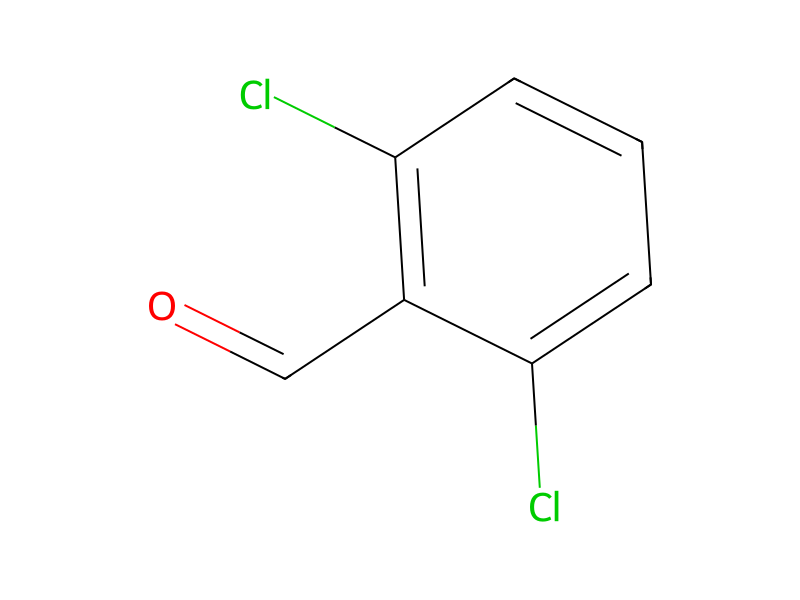
2,6-Dichlorobenzaldehyde → HCID 3096175, compound
Reaction equation

[Cl:1][C:2]1[CH:9]=[CH:8][CH:7]=[C:6]([Cl:10])[C:3]=1[CH:4]=O.[S:11]1[CH2:17][C:15](=[O:16])[NH:14][C:12]1=[S:13].C([O-])(=O)C.[Na+]>C(O)(=O)C>[Cl:1][C:2]1[CH:9]=[CH:8][CH:7]=[C:6]([Cl:10])[C:3]=1[CH:4]=[C:17]1[S:11][C:12](=[S:13])[NH:14][C:15]1=[O:16]Participants
5
Reactant 3


Product 1

Reagents, catalysts & solvents 1

Procedure
2,6-Dichlorobenzaldehyde (77.0 g), rhodanine (58.6 g), and acetic acid (539 ml) were suspended with stirring at room temperature. Anhydrous sodium acetate (116 g) was added to the suspension, and the resulting mixture was heated under reflux for 3 hours. The reaction mixture was cooled to 45° C., and ice water (700 ml) was added. After the mixture was stirred for 0.2 hours, the precipitated crystals were collected by filtration, washed with water, and then dried to obtain 2,6-dichlorobenzylidenerhodanine. Even in non-dried form, this product could be subjected to the subsequent step.
Workup
- temperaturethe resulting mixture was heated
- temperatureunder reflux for 3 hours
- temperatureThe reaction mixture was cooled to 45° C.
- stirringAfter the mixture was stirred for 0.2 hours
- filtrationthe precipitated crystals were collected by filtration
- washwashed with water
- customdried
Sources & evidence
- ORD record
- ord-66c1042d23de4925b6f63f08198741b1
- Source dataset
- uspto-grants-2015_12
- Patent number
- US09206169B2
Reaction notes
Loading…