Ethanol → 3-Ethenyl-2,6-difluorobenzonitrile
Reaction equation
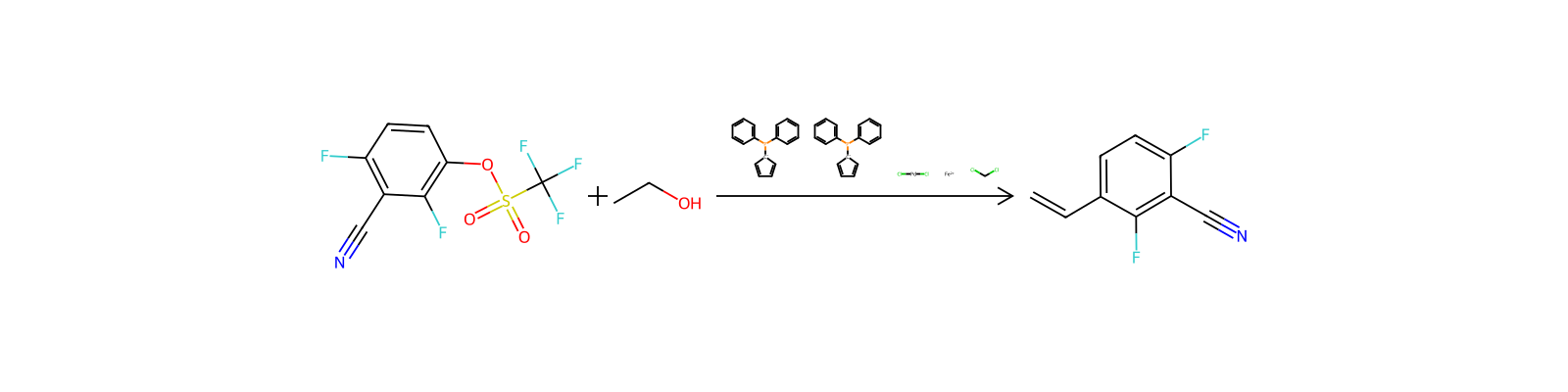
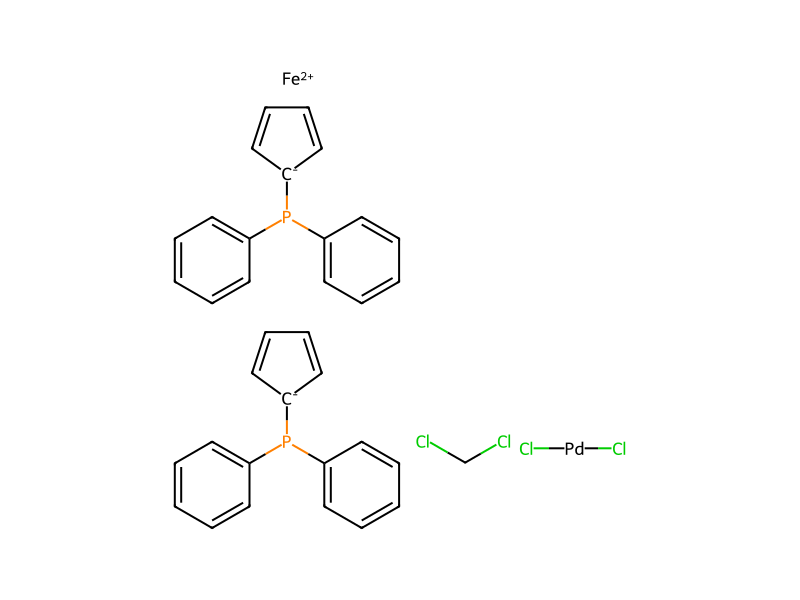
FC(F)(F)S(O[C:7]1[CH:12]=[CH:11][C:10]([F:13])=[C:9]([C:14]#[N:15])[C:8]=1[F:16])(=O)=O.[CH2:19](O)[CH3:20]>C1C=CC(P(C2C=CC=CC=2)[C-]2C=CC=C2)=CC=1.C1C=CC(P(C2C=CC=CC=2)[C-]2C=CC=C2)=CC=1.Cl[Pd]Cl.[Fe+2].C(Cl)Cl>[CH:19]([C:7]1[C:8]([F:16])=[C:9]([C:10]([F:13])=[CH:11][CH:12]=1)[C:14]#[N:15])=[CH2:20]Participants
4
Reactant 2


Product 1

Reagents, catalysts & solvents 1
Procedure
3-Cyano-2,4-difluorophenyl trifluoromethanesulfonate (5.20 g, 18.1 mmol), potassium vinyl trifluoroborate (4.85 g, 36.2 mmol), PdCl2(dppf)-CH2Cl2 Adduct (0.662 g, 0.905 mmol), and TEA (5.05 mL, 36.2 mmol) were added to 75 mL of ethanol. The reaction mixture was degassed then heated at reflux for 4 h. LC-MS analysis confirmed product peak. The reaction mixture was diluted with ethyl acetate, washed twice with brine, dried, and evaporated to dryness. The crude material was then purified by MPLC chromatography through a 330 g Redi-sep column eluting with 10% EtOAc/Hexane solvent system to yield 3-ethenyl-2,6-difluorobenzonitrile.
Workup
- customThe reaction mixture was degassed
- temperaturethen heated
- temperatureat reflux for 4 h
- additionThe reaction mixture was diluted with ethyl acetate
- washwashed twice with brine
- customdried
- customevaporated to dryness
- customThe crude material was then purified by MPLC chromatography through a 330 g Redi-sep column
- washeluting with 10% EtOAc/Hexane solvent system
Sources & evidence
- ORD record
- ord-ea8dbff2fa5d4f8b89cf845585d25a44
- Source dataset
- uspto-grants-2015_12
- Patent number
- US09206199B2
Reaction notes
Loading…