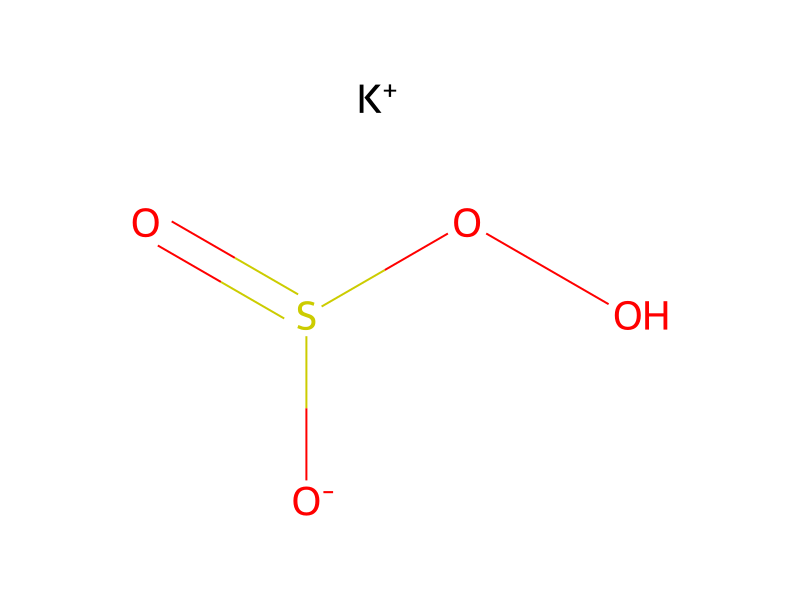
Potassium hydroxy sulfite → HCID 136413190, compound
Reaction equation

[Cl:1][C:2]1[CH:11]=[C:10]2[C:5]([C:6](B3OC(C)(C)C(C)(C)O3)=[C:7]([C:12]3[CH:17]=[CH:16][CH:15]=[CH:14][C:13]=3[Cl:18])[N:8]=[CH:9]2)=[CH:4][N:3]=1.[OH:28]OS([O-])=O.[K+]>CO.ClCCl>[Cl:1][C:2]1[CH:11]=[C:10]2[C:5]([C:6]([OH:28])=[C:7]([C:12]3[CH:17]=[CH:16][CH:15]=[CH:14][C:13]=3[Cl:18])[N:8]=[CH:9]2)=[CH:4][N:3]=1Participants
5
Reactant 2

Product 1

Reagents, catalysts & solvents 2


Procedure
A mixture of 7-chloro-3-(2-chlorophenyl)-4-(4,4,5,5-tetramethyl-1,3,2-dioxaborolan-2-yl)-2,6-naphthyridine (60 mg, 0.1 mmol) and Oxone® (370 mg, 0.6 mmol) in wet methanol (0.6 mL) and dichloromethane (0.2 mL) was stirred at 35° C. for 3 hours. The cooled reaction mixture was diluted with dichloromethane (50 mL) and washed with 1.0M citric acid in water (20 mL). The organic layer was separated, dried over sodium sulfate, filtered, and evaporated in vacuo to afford an orange/red residue that was used in the next step without further purification (50 mg, 100%).
Workup
- customThe cooled reaction mixture
- washwashed with 1.0M citric acid in water (20 mL)
- customThe organic layer was separated
- dry with materialdried over sodium sulfate
- filtrationfiltered
- customevaporated in vacuo
- customto afford an orange/red residue that
- customwas used in the next step without further purification (50 mg, 100%)
Sources & evidence
- ORD record
- ord-5899cf61a6384827876cb07ab58848d8
- Source dataset
- uspto-grants-2015_12
- Patent number
- US09206175B2
Reaction notes
Loading…