Carbon Dioxide → 4,6-Dichloro-2-(methylthio)pyrimidine-5-carboxylic acid
Reaction equation

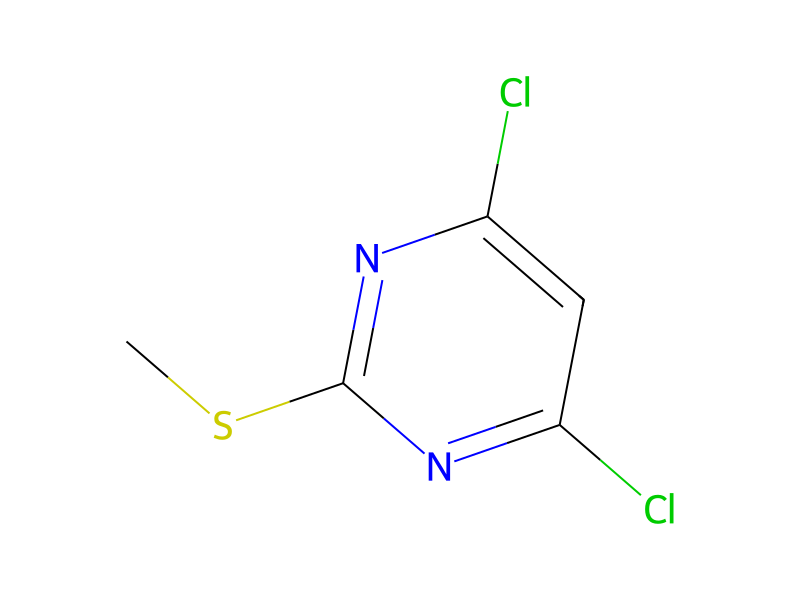
[Cl:1][C:2]1[CH:7]=[C:6]([Cl:8])[N:5]=[C:4]([S:9][CH3:10])[N:3]=1.C(NC(C)C)(C)C.C([Li])CCC.[C:23](=[O:25])=[O:24]>>[Cl:1][C:2]1[C:7]([C:23]([OH:25])=[O:24])=[C:6]([Cl:8])[N:5]=[C:4]([S:9][CH3:10])[N:3]=1Participants




Procedure
Methyl iodide can be added to a solution of 2-thioxo-dihydropyrimidine-4,6(1H,5H)-dione and aqueous sodium hydroxide to provide 2-(methylthio)pyrimidine-4,6-diol. The reaction is typically performed in a solvent such as but not limited to ethanol, and may require the use of heat. Addition of phosphorus oxychloride to 2-(methylthio)pyrimidine-4,6-diol will provide 4,6-dichloro-2-(methylthio)pyrimidine. The reaction is typically done at elevated temperature without an additional solvent. 4,6-Dichloro-2-(methylthio)pyrimidine can be added to a mixture of diisopropylamine and n-butyl lithium, followed by the addition of dry carbon dioxide gas to provide 4,6-dichloro-2-(methylthio)pyrimidine-5-carboxylic acid. The reaction is typically performed at reduced temperature in a solvent such as but not limited to tetrahydrofuran. A mixture of 4,6-dichloro-2-(methylthio)pyrimidine-5-carboxylic acid and thionyl chloride can be refluxed together and concentrated, followed by the addition of aqueous ammonia at reduced temperature in a solvent such as but not limited to tetrahydrofuran to provide 4,6-dichloro-2-(methylthio)pyrimidine-5-carboxamide. A compound of formula (1A) wherein B, R2, R3, and m are as described herein, can be reacted with 4,6-dichloro-2-(methylthio)pyrimidine-5-carboxamide in the presence of a base such as but not limited to N,N-diisopropylethylamine to provide compounds of formula (4). The reaction typically requires the use of heat and a solvent such as but not limited to 1,4-dioxane. Compounds of formula (5) can be prepared by reacting compounds of formula (4) with hydrazine hydrate. The reaction is typically performed at ambient temperature in a solvent such as but not limited to 1,4-dioxane. Methyl orthoformate can be reacted with compounds of formula (5) to provide compounds of formula (6). The reaction may require the use of heat. Compounds of formula (7), which are representative of the compounds of Formula (I), can be prepared by reacting compounds of formula (6) with an organozinc compound of formula (2A), wherein Z, A, R1, and n are as described herein and XA is a halide. The reaction typically involves the use of heat and a nickel or palladium catalyst such as but not limited to bis(triphenylphosphine)palladium(II) dichloride or tetrakis(triphenylphosphine)palladium(0) in a solvent such as but not limited to N-methylpyrrolidone, tetrahydrofuran, or mixtures thereof.
Sources & evidence
- ORD record
- ord-ff6c7d87e10b454bba09e3c0082aecef
- Source dataset
- uspto-grants-2015_12
- Patent number
- US09212192B2
Reaction notes
Loading…