L-Lysine → L-Lysine, acetate (1:1)
Reaction equation

[NH2:1][C@H:2]([C:8]([OH:10])=[O:9])[CH2:3][CH2:4][CH2:5][CH2:6][NH2:7]>C(O)(=O)C>[C:8]([OH:10])(=[O:9])[CH3:2].[NH2:1][C@H:2]([C:8]([OH:10])=[O:9])[CH2:3][CH2:4][CH2:5][CH2:6][NH2:7]Participants
3
Reactant 1
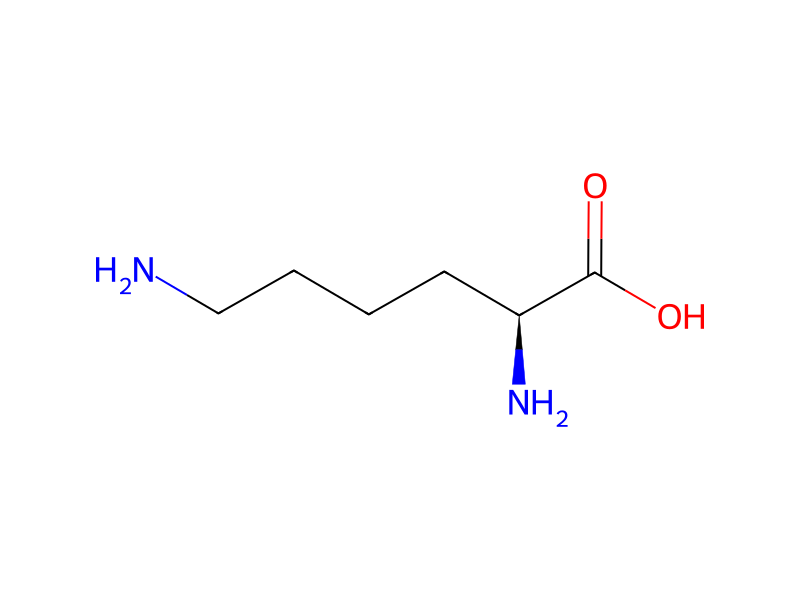
Product 1

Reagents, catalysts & solvents 1

Conditions
- Temperature
- 15 °C
Procedure
To the above effluent solution obtained by the method of Example 2, acetic acid was added so as to become 1.0 molar equivalent with L-lysine, and decolored by activated carbon, followed by filtration. The filtrate was concentrated to 95 g/dL L-lysine under reduced pressure, cooled to 15° C., and crystals were separated by centrifugation. The resulting crystals ware washed with 100% methanol, and dried under reduced pressure to obtain L-lysine acetic acid salt product. The recovery of the product from the feed solution (yield of L-lysine) was 57.6%. The purity of the product was examined according to the method described in Japanese Pharmacopoeia, 16th Revision (pp 1385-1386), and found to be 100%.
Workup
- additionwas added so as
- filtrationfollowed by filtration
- concentrationThe filtrate was concentrated to 95 g/dL L-lysine under reduced pressure
- customcrystals were separated by centrifugation
- washThe resulting crystals ware washed with 100% methanol
- customdried under reduced pressure
Sources & evidence
- ORD record
- ord-fba20f3cd686435887f6b056e20a56ee
- Source dataset
- uspto-grants-2015_12
- Patent number
- US09216946B2
Reaction notes
Loading…