Diethylamine → 2-(Diethylamino)acetamide
Reaction equation

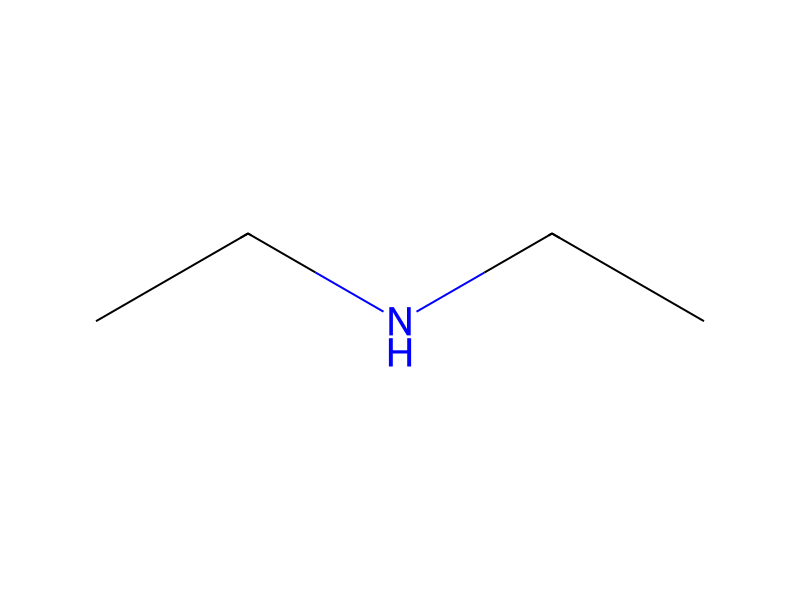
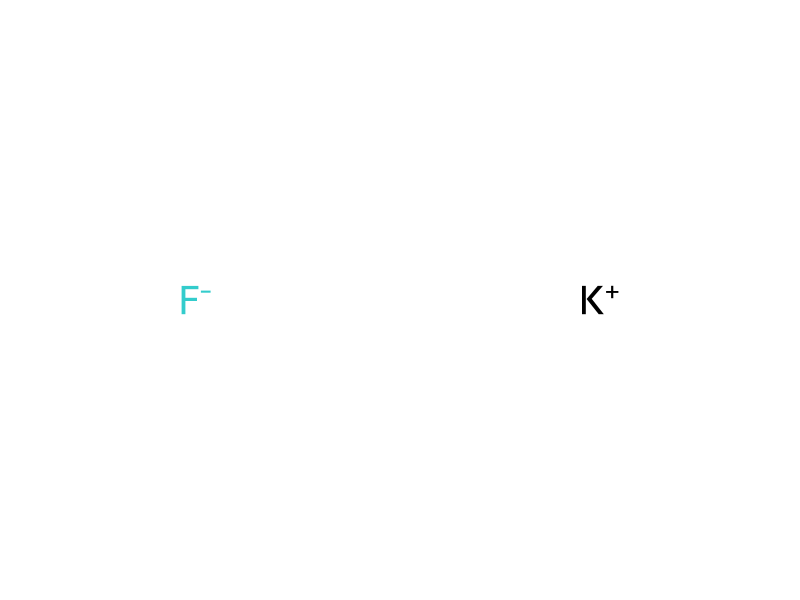
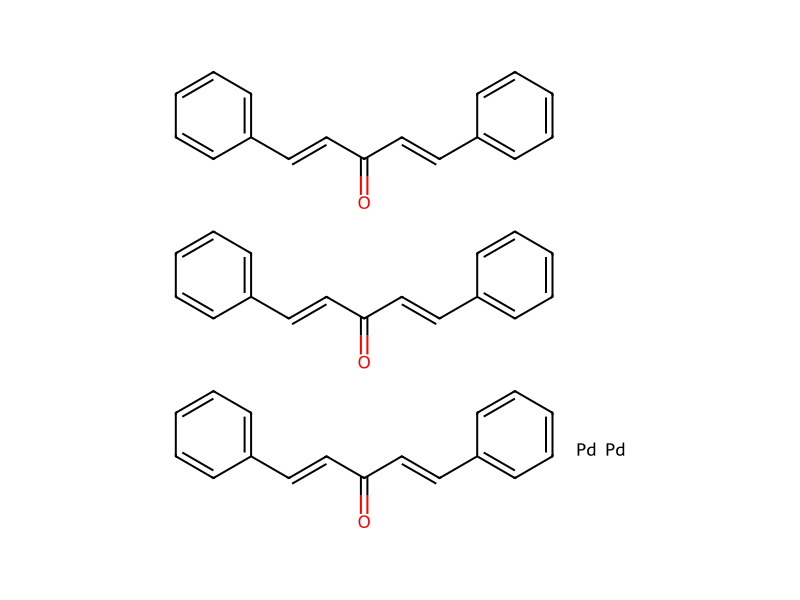
[F-].[K+].C1(P(C2CCCCC2)C2(N(C)C)CC=CC=C2C2C=CC=CC=2)CCCCC1.[CH2:31]([NH:33][CH2:34][CH3:35])[CH3:32].Br[CH2:37][C:38]([NH2:40])=[O:39]>C1C=CC(/C=C/C(/C=C/C2C=CC=CC=2)=O)=CC=1.C1C=CC(/C=C/C(/C=C/C2C=CC=CC=2)=O)=CC=1.C1C=CC(/C=C/C(/C=C/C2C=CC=CC=2)=O)=CC=1.[Pd].[Pd]>[CH2:31]([N:33]([CH2:34][CH3:35])[CH2:37][C:38]([NH2:40])=[O:39])[CH3:32]Participants



Conditions
- Temperature
- 105 °C
Procedure
All coupling reactions were carried out under argon using Schlenk techniques. Toluene was freshly distilled from CaH2 prior to use and tetrahydrofuran (THF) was dried by passage through solvent purification system VAC to provide water content of less than 25 ppm as was determined by coulometric KF titrator Mettler Toledo. All other solvents were used as purchased from commercial sources. 2-Dicyclohexylphosphino-2-(N,N-dimethylamino)biphenyl (DavePhos), diethylamine, 2-bromoacetamide and tris(dibenzylideneacetone)dipalladium were used as purchased (Sigma-Aldrich, St.-Louis, Mo.). The 2-diethylaminoacetamide was synthesized following in-house developed procedure. All iodo-carboranes were azeotropically dried with benzene to remove any trace of water. Tribasic potassium phosphate was ground to a fine powder and then dried thoroughly by heating under vacuum at 105° C. All solids were stored in an argon-filled glove box. Silica gel was used as purchased (63-200 μm, Sorbent Technologies, Inc.). Analytical thin-layer chromatography (TLC) for carborane identification was performed by using pre-coated silica-gel XHL plates (Sorbent Technologies, Inc.) and visualized by dipping into an acidified (hydrochloric acid) solution of PdCl2 followed by heating. 11B NMR spectra were obtained using BrukerAvance 400 and Avance 500 spectrometers and externally referenced to BF3 Et2O and the peaks upfield of the reference were designated as negative. 1H NMR and 13C NMR spectra were acquired on BrukerAvance 400 and Avance 500 spectrometers. Chemical shifts are given in ppm relative to residual solvent signals (CDCl3, δ=7.24 ppm for 1H NMR and 77.0 ppm for 13C NMR). 19F NMR spectra were acquired on BrukerAvance 400 and chemical shifts are given relative to the external BF3-Et2O reference (δ=−153.0 ppm). Mass spectra were obtained on an ABI QSTAR and Mariner Biospectrometry Workstation by PerSeptive Biosystems. Melting points were obtained using automated melting point system OptiMelt (Stanford research system). Measurements were conducted in open-end Kimble Chase capillary tubes from borosilicate glass (L=90 mm). The melting point range is defined as the interval between the onset and clear points using 0.5° C./min ramp rate.
Workup
- distillationToluene was freshly distilled from CaH2
- dry with materialtetrahydrofuran (THF) was dried by passage through solvent purification system VAC
- customto provide water content of less than 25 ppm
- dry with materialAll iodo-carboranes were azeotropically dried with benzene
- customto remove any trace of water
- customdried thoroughly
- additionfilled glove box
- temperatureby heating
Sources & evidence
- ORD record
- ord-e8cb4223ee264393b7cfd5012ea5a018
- Source dataset
- uspto-grants-2015_12
- Patent number
- US09217002B2
Reaction notes
Loading…