Pyridine → HCID 58374067, compound
Reaction equation

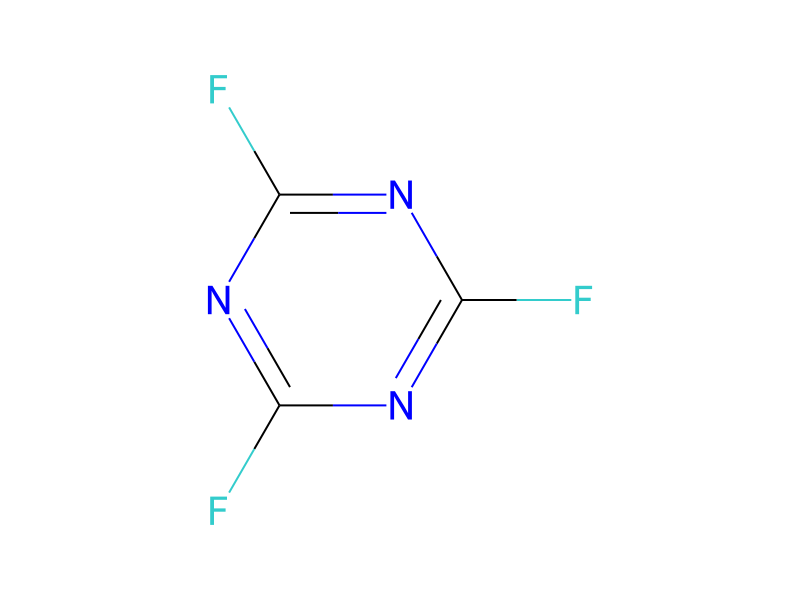
[C:1]1([C:7]2[C:11]([C:12]([F:15])([F:14])[F:13])=[C:10]([C:16]([OH:18])=O)[O:9][N:8]=2)[CH:6]=[CH:5][CH:4]=[CH:3][CH:2]=1.N1C=CC=CC=1.[F:25]C1N=C(F)N=C(F)N=1>ClCCl>[C:1]1([C:7]2[C:11]([C:12]([F:15])([F:14])[F:13])=[C:10]([C:16]([F:25])=[O:18])[O:9][N:8]=2)[CH:6]=[CH:5][CH:4]=[CH:3][CH:2]=1Participants
Reactant 3


Product 1

Reagents, catalysts & solvents 1

Procedure
To a mixture of 3-phenyl-4-(trifluoromethyl)isoxazole-5-carboxylic acid (Intermediate I-3D, 3.00 g, 11.7 mmol) and pyridine (1.13 mL, 14.0 mmol) in dichloromethane (100 mL) at room temperature was added 2,4,6-trifluoro-1,3,5-triazine (cyanuric fluoride) (1.18 mL, 14.0 mmol). The reaction mixture was stirred at room temperature overnight, diluted with dichloromethane (300 mL), washed with an ice-cold solution of 0.5N aqueous hydrochloric acid (2×100 mL), and the organic layer was collected. The aqueous layer was back-extracted with dichloromethane (200 mL), and the combined organic layers were dried anhydrous sodium sulfate and concentrated to afford 3-phenyl-4-(trifluoromethyl)isoxazole-5-carbonyl fluoride (2.91 g, 11.2 mmol, 96% yield) as a yellow, viscous oil. The product was found to react readily with methanol and on analysis was characterized as the methyl ester, which had an HPLC ret. time=2.56 min. —(Condition A); LC/MS M+1=272.3 (methyl ester).
Workup
- washwashed with an ice-cold solution of 0.5N aqueous hydrochloric acid (2×100 mL)
- customthe organic layer was collected
- extractionThe aqueous layer was back-extracted with dichloromethane (200 mL)
- concentrationconcentrated
Sources & evidence
- ORD record
- ord-468bf760c07249fb9f8333a6a21546e8
- Source dataset
- uspto-grants-2015_12
- Patent number
- US09216972B2
Reaction notes
Loading…