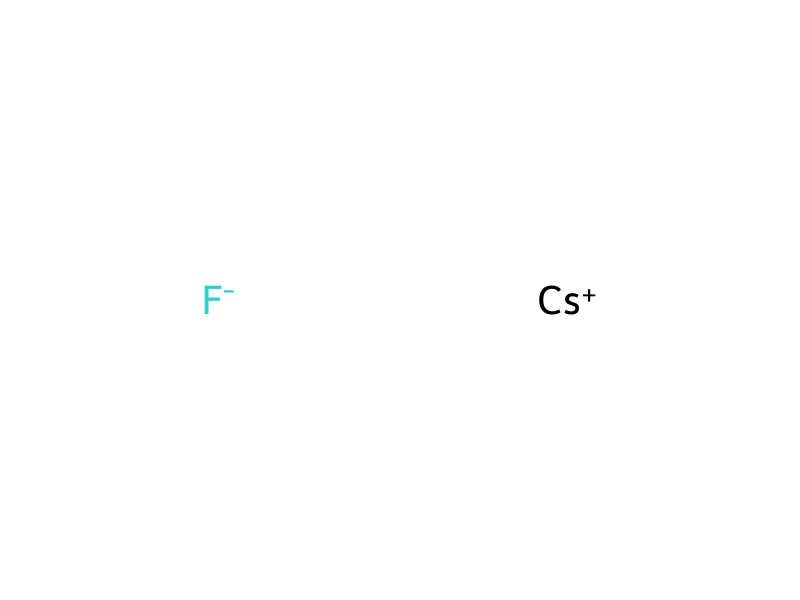
Cesium fluoride → [6-Benzyloxy-2-(2,4-difluoro-phenyl)-naphthalen-1-yl]-[4-(2-piperidin-1-yl-ethoxy)-phenyl]-methanone
Reaction equation

[CH2:1]([O:8][C:9]1[CH:10]=[C:11]2[C:16](=[CH:17][CH:18]=1)[C:15]([C:19](=[O:35])[C:20]1[CH:25]=[CH:24][C:23]([O:26][CH2:27][CH2:28][N:29]3[CH2:34][CH2:33][CH2:32][CH2:31][CH2:30]3)=[CH:22][CH:21]=1)=[C:14](OS(C(F)(F)F)(=O)=O)[CH:13]=[CH:12]2)[C:2]1[CH:7]=[CH:6][CH:5]=[CH:4][CH:3]=1.B1(B2OCC(C)(C)CO2)OCC(C)(C)CO1.[F-].[Cs+].Br[C:63]1[CH:68]=[CH:67][C:66]([F:69])=[CH:65][C:64]=1[F:70]>C1CCC(P(C2CCCCC2)C2CCCCC2)CC1.C1CCC(P(C2CCCCC2)C2CCCCC2)CC1.[Pd].C(#N)C>[CH2:1]([O:8][C:9]1[CH:10]=[C:11]2[C:16](=[CH:17][CH:18]=1)[C:15]([C:19]([C:20]1[CH:21]=[CH:22][C:23]([O:26][CH2:27][CH2:28][N:29]3[CH2:34][CH2:33][CH2:32][CH2:31][CH2:30]3)=[CH:24][CH:25]=1)=[O:35])=[C:14]([C:63]1[CH:68]=[CH:67][C:66]([F:69])=[CH:65][C:64]=1[F:70])[CH:13]=[CH:12]2)[C:2]1[CH:3]=[CH:4][CH:5]=[CH:6][CH:7]=1Participants
Reactant 4


Product 1

Reagents, catalysts & solvents 2


Procedure
Add trifluoromethanesulfonic acid 6-benzyloxy-1-[4-(2-piperidin-1-yl-ethoxy)-benzoyl]-naphthalen-2-yl ester (0.45 g, 0.73 mmol), bis(neopentyl glycolato)diboron (0.18 g, 0.81 mmol), bis(tricyclohexylphosphine)palladium(0) (0.098 g, 0.15 mmol) and acetonitrile (7.5 mL) to a round bottom flask. Stir at ambient temperature for approximately 5 minutes to dissolve most of the reagents. Add cesium fluoride (1.00 g, 6.61 mmol), place the flask in a 90° C. oil bath, and stir under nitrogen for 2-3 minutes. Now add 1-bromo-2,4-difluorobenzene (0.174 mL, 1.54 mmol) and stir for 20 minutes. At this time add more 1-bromo-2,4-difluorobenzene (0.06 mL, 0.53 mmol) and continue stirring the reaction for 2 hours at 90° C. At this time add more 1-bromo-2,4-difluorobenzene (0.05 mL, 0.44 mmol) and continue stirring for another 2 hours. Cool the reaction to ambient temperature and then filter it through a pad of Celite. Rinse the pad with ample, hot ethyl acetate. Wash the filtrate in a separatory funnel with 50% aqueous sodium carbonate, saturated aqueous ammonium chloride, H2O and brine; then dry (sodium sulfate) and evaporate it in vacuo. Load resulting material onto an SCX column, wash with dichloromethane, 50% dichloromethane/methanol, elute with ammonia solution (2N NH3 in methanol) and remove solvent under vacuum. Purify the resulting residue by flash chromatography (silica gel; 1.5%-3% methanol gradient in dichloromethane) to provide 0.245 g (58%) of the title compound: mass spectrum (ion spray) m/z=578 (M+H).
Workup
- dissolutionto dissolve most of the reagents
- stirringcontinue stirring
- customthe reaction for 2 hours at 90° C
- stirringcontinue stirring for another 2 hours
- temperatureCool
- customthe reaction to ambient temperature
- filtrationfilter it through a pad of Celite
- washRinse the pad with ample, hot ethyl acetate
- washWash the filtrate in a separatory funnel with 50% aqueous sodium carbonate, saturated aqueous ammonium chloride, H2O and brine
- dry with materialthen dry (sodium sulfate)
- customevaporate it in vacuo
- customLoad resulting material onto an SCX column
- washwash with dichloromethane, 50% dichloromethane/methanol
- washelute with ammonia solution (2N NH3 in methanol)
- customremove solvent under vacuum
- customPurify the resulting residue by flash chromatography (silica gel; 1.5%-3% methanol gradient in dichloromethane)
Sources & evidence
- ORD record
- ord-efb9870f2eab4b8883e8f748478c8008
- Source dataset
- uspto-grants-2012_07
- Patent number
- US08217032B2
Reaction notes
Loading…