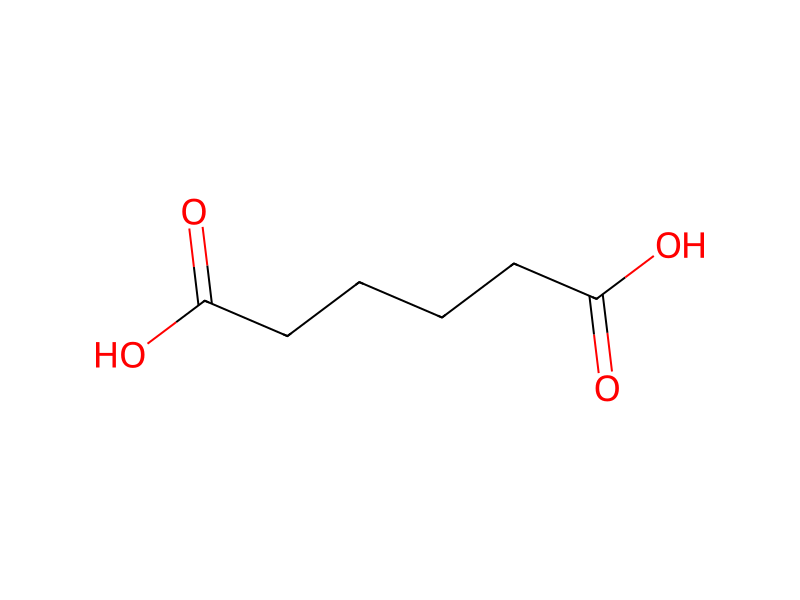
Ammonia → Adipic Acid
Reaction equation

N.[C:2]([OH:11])(=[O:10])/[CH:3]=[CH:4]/[CH:5]=[CH:6]/[C:7]([OH:9])=[O:8]>O1CCOCC1>[C:2]([OH:11])(=[O:10])[CH2:3][CH2:4][CH2:5][CH2:6][C:7]([OH:9])=[O:8]Participants
Reactant 2


Product 1
Reagents, catalysts & solvents 1

Procedure
For reference, effect of temperature and time of catalytic reduction on reaction yield are studied using a 500 mL Parr reactor, 50 psi NH3, dioxane (0.07M, 1 wt %) and 5 wt % 5% Pd/Al2O3 catalyst are studied using trans,trans-muconic acid as the substrate. The trans,trans-muconic acid is hydrogenated in situ by the catalyst to form adipic acid. Initial hydrogen pressure is 200 psi, so that the total initial pressure after charging with hydrogen is 250 psi. Results are shown in Table 5A. The time listed includes the beginning of heating a room temperature to the time at which the reaction is cooled down. The temperature ramp time from room temperature to 250° C. is 45-60 min. At 225° C. (entry 3), adipamide is the main product as hydrogenation is relatively slow at this temperature. Also observed is the presence of monoamide, showing amidification is not complete. Increasing reaction temperature to 250° C. (entry 1) results in complete amidification and increases rate of hydrogenation of adipamide to an intermediate 6-aminohexanamide which cyclizes to form caprolactam. Increasing reaction time to 3 h (entry 2) results in complete reduction of the adipamide but also increases the reduction of caprolactam to HMI. The reaction is heated to 250° C. for a time that allows formation of caprolactam without undesired production of HMI. ND=not detected. t, t-MA=trans,trans-muconic acid.
Workup
- customFor reference, effect of temperature and time of catalytic reduction on reaction
- customyield
Sources & evidence
- ORD record
- ord-2885a4c8055b424595947621635fbc4e
- Source dataset
- uspto-grants-2015_07
- Patent number
- US09073867B2
Reaction notes
Loading…