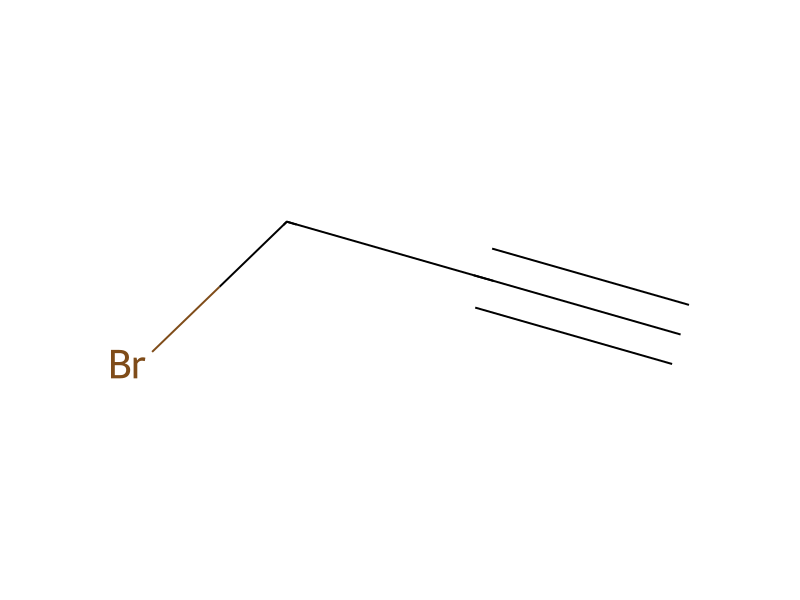
Propargyl bromide → HCID 59588123, compound
Reaction equation

[N:1]([C:4]1[CH:9]=[CH:8][C:7]([N+:10]([O-])=O)=[CH:6][CH:5]=1)=[N+:2]=[N-:3].Br[CH2:14][C:15]#[CH:16]>C1(C)C=CC=CC=1>[CH3:16][C:15]1[N:3]=[N:2][N:1]([C:4]2[CH:9]=[CH:8][C:7]([NH2:10])=[CH:6][CH:5]=2)[CH:14]=1Participants
Reactant 2

Product 1

Reagents, catalysts & solvents 1

Conditions
- Temperature
- 60 °C
Procedure
A solution of 1-azido-4-nitrobenzene (0.500 g, 3.05 mmol) and 3-bromoprop-1-yne (1.45 g, 12.2 mmol) in toluene (3 mL) was heated to 60° C. for 24 hours in a sealed tube. Additional 3-bromoprop-1-yne (1.45 g, 12.2 mmol) was added and the solution stirred at 60° C. overnight. The reaction mixture was concentrated to an orange solid. The crude residue was dissolved in ethanol (100 mL). 10 wt % Palladium on carbon (150 mg) was added and the mixture was pressurized to 50 psi hydrogen and stirred for 18 hours. The reaction mixture was filtered through celite and the filtrate was concentrated. The residue was slurried in ethyl acetate. The mixture was filtered, and the solid dried under vacuum to give 4-(4-methyl-1H-1,2,3-triazol-1-yl)aniline (300 mg). 1HNMR (400 MHz, CD3OD, δ): 8.37 (s, 1H), 8.03 (m, 2H), 7.58 (m, 2H), 2.44 (s, 3H).
Workup
- concentrationThe reaction mixture was concentrated to an orange solid
- dissolutionThe crude residue was dissolved in ethanol (100 mL)
- addition10 wt % Palladium on carbon (150 mg) was added
- stirringstirred for 18 hours
- filtrationThe reaction mixture was filtered through celite
- concentrationthe filtrate was concentrated
- filtrationThe mixture was filtered
- customthe solid dried under vacuum
Sources & evidence
- ORD record
- ord-d44281b3d93c41cf873dde6594d3fa0e
- Source dataset
- uspto-grants-2015_07
- Patent number
- US09073871B2
Reaction notes
Loading…