Potassium Carbonate → 2-(4-(Quinolin-7-yl)phenyl)acetonitrile
Reaction equation

Br[C:2]1[CH:7]=[CH:6][C:5]([CH2:8][C:9]#[N:10])=[CH:4][CH:3]=1.CC1(C)C(C)(C)OB([C:19]2[CH:28]=[C:27]3[C:22]([CH:23]=[CH:24][CH:25]=[N:26]3)=[CH:21][CH:20]=2)O1.C(=O)([O-])[O-].[K+].[K+]>O1CCOCC1.C1C=CC(P(C2C=CC=CC=2)[C-]2C=CC=C2)=CC=1.C1C=CC(P(C2C=CC=CC=2)[C-]2C=CC=C2)=CC=1.Cl[Pd]Cl.[Fe+2].C(Cl)Cl>[N:26]1[C:27]2[C:22](=[CH:21][CH:20]=[C:19]([C:2]3[CH:7]=[CH:6][C:5]([CH2:8][C:9]#[N:10])=[CH:4][CH:3]=3)[CH:28]=2)[CH:23]=[CH:24][CH:25]=1Participants
Reactant 3



Product 1

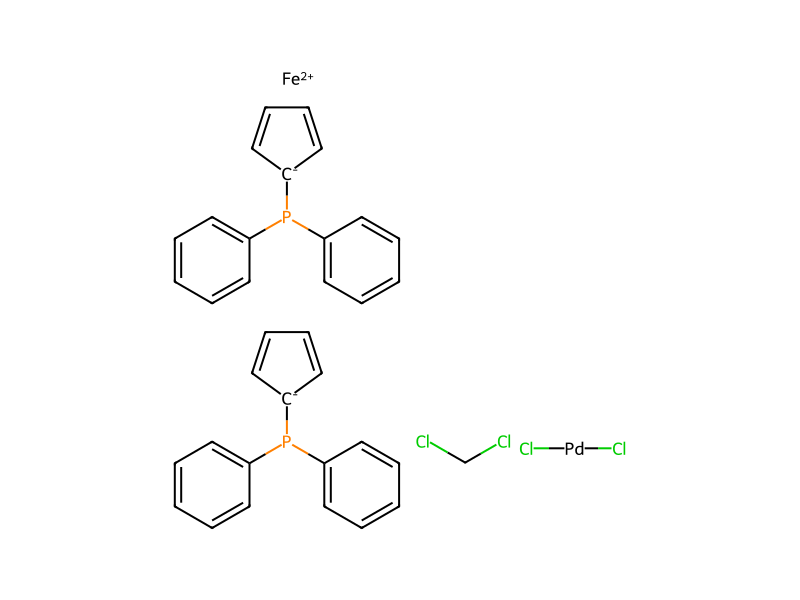
Reagents, catalysts & solvents 2

Procedure
A solution of 2-(4-bromophenyl)acetonitrile (2.55 mmol) in 1,4-dioxane (5 mL) was treated with 7-(4,4,5,5-tetramethyl-1,3,2-dioxaborolan-2-yl)quinoline (2.64 mmol), PdCl2(dppf)-CH2Cl2 adduct (0.083 mmol), and 2M aq potassium carbonate (5.10 mmol). The reaction vessel was purged with nitrogen and sealed, and the mixture irradiated in a Biotage Initiator Microwave at 120° C. for 20 min. The resulting black mixture was diluted with water (100 mL) and extracted three times with dichloromethane. The combined organic layers were dried over sodium sulfate, filtered and concentrated in vacuo. Purification of the residue by silica gel chromatography (0-100% ethyl acetate/hexanes) afforded the title compound as a yellow solid (424 mg, 64%). MS(ES)+ m/e 245.3 [M+H]+.
Workup
- customThe reaction vessel was purged with nitrogen
- customsealed
- customthe mixture irradiated in a Biotage Initiator Microwave at 120° C. for 20 min
- additionThe resulting black mixture was diluted with water (100 mL)
- extractionextracted three times with dichloromethane
- dry with materialThe combined organic layers were dried over sodium sulfate
- filtrationfiltered
- concentrationconcentrated in vacuo
- customPurification of the residue by silica gel chromatography (0-100% ethyl acetate/hexanes)
Sources & evidence
- ORD record
- ord-85c2084202434537b52b323faa031d87
- Source dataset
- uspto-grants-2015_07
- Patent number
- US09084794B2
Reaction notes
Loading…