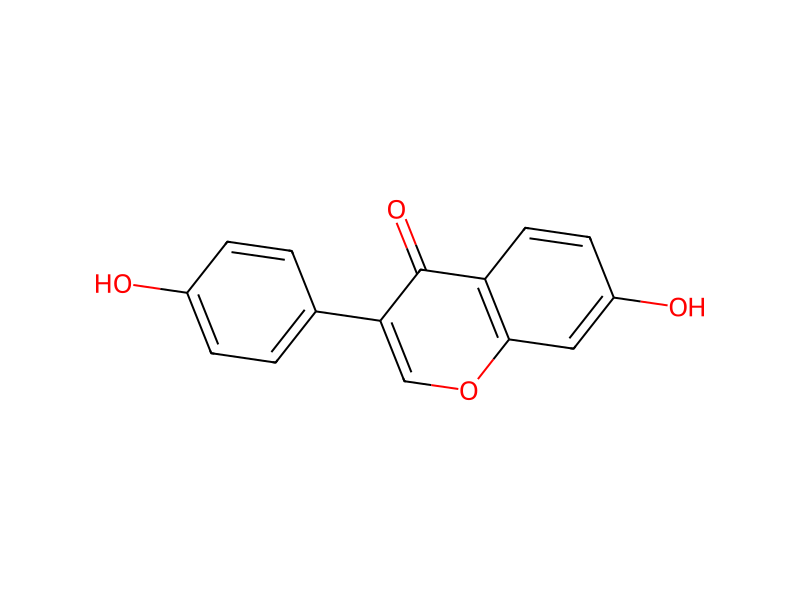
Daidzein → Equol
Reaction equation

[CH:1]1[C:6]([C:7]2[C:16](=O)[C:15]3[CH:14]=[CH:13][C:12]([OH:18])=[CH:11][C:10]=3[O:9][CH:8]=2)=[CH:5][CH:4]=[C:3]([OH:19])[CH:2]=1.C(O)(C)C.CCCCCC>C(O)(=O)C.C(O)(C)C.[Pd]>[CH:5]1[C:6]([C@H:7]2[CH2:8][O:9][C:10]3[CH:11]=[C:12]([OH:18])[CH:13]=[CH:14][C:15]=3[CH2:16]2)=[CH:1][CH:2]=[C:3]([OH:19])[CH:4]=1Participants
Reactant 2

Product 1

Reagents, catalysts & solvents 3



Procedure
Daidzein (200 mg, 0.8 mmol) is dissolved in a mixture of glacial acetic acid (20 mL) and isopropanol (20 mL), and is reduced with 10% Pd on charcoal (150 mg) at 55 p.s.i.g. (3.7 atm gauge). At the end of the reaction (2 hours, TLC:isopropanol/n-hexane 1/4) the catalyst is filtered off, and the filtrate is evaporated. The crude residue is purified by chromatography on a silica gel column using as eluent a mixture of isopropanol and n-hexane (1:4 v/v), to give (±) equol as a pure product (160 mg, yield: 82%) crystallized from n-hexane. The product, colorless crystals, is not hygroscopic, is stable in air, and does not decompose during the final filtration procedure. The product of this chemical synthesis was in all respects identical with an authentic sample of (±) equol (racemic equol). FIG. 4 shows the GC-MS analysis of the trimethylsilyl ether derivative of synthesized product as a single pure peak and a mass spectrum that is consistent with the published electron ionization spectrum of the trimethylsilyl (TMS) ether derivative of authentic equol. The molecular ion as expected is at m/z 470 and the base peak at m/z 234. The purified equol product had a purity of greater than 99%, as confirmed by HPLC and mass spectrometry.
Workup
- filtrationis filtered off
- customthe filtrate is evaporated
- customThe crude residue is purified by chromatography on a silica gel column
- additiona mixture of isopropanol and n-hexane (1:4 v/v)
Sources & evidence
- ORD record
- ord-71b21075e08b4e318690fdc858d43f2f
- Source dataset
- uspto-grants-2015_07
- Patent number
- US09089547B2
Reaction notes
Loading…