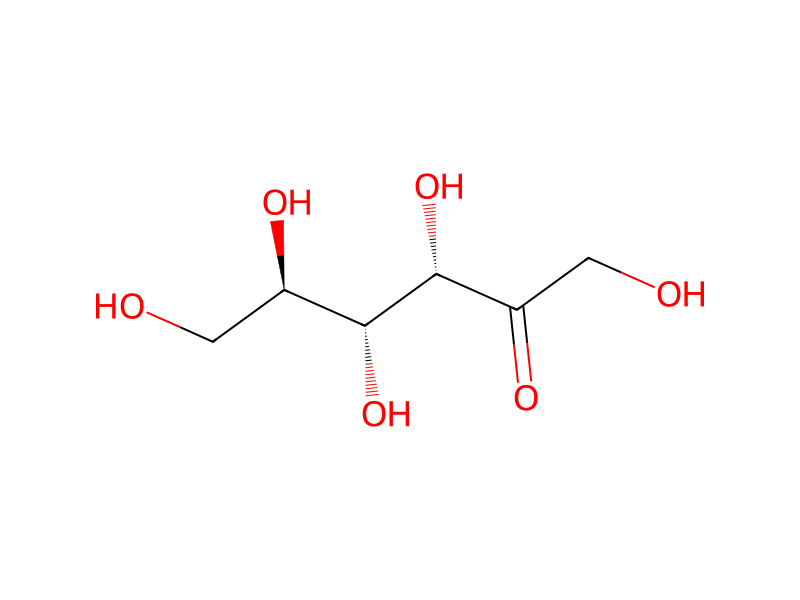
D-(-)-Fructose → Isoamyl levulinate
Reaction equation

O[CH2:2][C:3]([C@H:5]([C@@H:7]([C@@H:9](CO)[OH:10])O)O)=[O:4].[CH2:13]([OH:18])[CH2:14][CH:15]([CH3:17])[CH3:16]>OS(O)(=O)=O>[C:9]([O:18][CH2:13][CH2:14][CH:15]([CH3:17])[CH3:16])(=[O:10])[CH2:7][CH2:5][C:3]([CH3:2])=[O:4]Participants
4
Reactant 2

Product 1

Reagents, catalysts & solvents 1

Conditions
- Temperature
- 160 °C
Procedure
In the second experiment, a mixture of crystalline fructose (10 g) in isoamyl alcohol (40 mL) and concentrated H2SO4 (0.10 mL) was placed in a sealed Teflon-lined reaction vessel inside a high-density rotor for treatment in a MicroSYNTH Microwave Labstation. The sample was heated from room temperature via microwaves to 160° C. in 3 min., and kept there for 20 min. using an irradiation power of 1000 Watts. The vessel was cooled. Analysis indicates a 61% molar yield of isoamyl HMF and 27% yield of isoamyl levulinate from fructose. These same conditions, when performed with a conventional heating system, produced 33% molar yield of isoamyl HMF and 24% molar yield of isoamyl levulinate.
Workup
- customreaction vessel inside a high-density rotor for treatment in a MicroSYNTH Microwave Labstation
- temperatureThe vessel was cooled
Sources & evidence
- ORD record
- ord-5f0f9fb13eb94737bd2160c2b573ede2
- Source dataset
- uspto-grants-2015_07
- Patent number
- US09090550B2
Reaction notes
Loading…