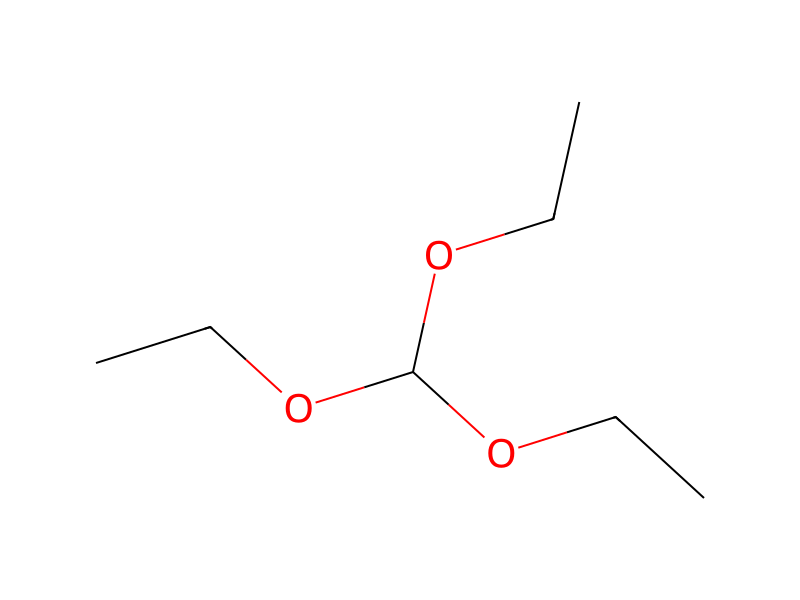
Ethyl orthoformate → 2-(4-(4,4,5,5-Tetramethyl-1,3,2-dioxaborolan-2-yl)phenyl)-1,3,4-oxadiazole
Reaction equation

[CH3:1][C:2]1([CH3:19])[C:6]([CH3:8])([CH3:7])[O:5][B:4]([C:9]2[CH:18]=[CH:17][C:12]([C:13]([NH:15][NH2:16])=[O:14])=[CH:11][CH:10]=2)[O:3]1.[CH:20](OCC)(OCC)OCC>C(O)C>[CH3:8][C:6]1([CH3:7])[C:2]([CH3:19])([CH3:1])[O:3][B:4]([C:9]2[CH:18]=[CH:17][C:12]([C:13]3[O:14][CH:20]=[N:16][N:15]=3)=[CH:11][CH:10]=2)[O:5]1Participants
4



Procedure
10 g (38 mmol) of 2-[4-(4,4,5,5-tetramethyl-1,3,2-dioxaborolan-2-yl)-benzohydrazide are dissolved in 30 g (20 mmol) of triethyl orthoformate, and the mixture is heated to reflux. The ethanol formed during the reaction is continuously removed by distillation. After the mixture has cooled, the product crystallizes out, is filtered off and washed with a little ethanol. Yield: 8.7 g (32 mmol, 84%). An analogous procedure is carried out using the compounds of the formula (II) shown in Table 4.
Workup
- temperaturethe mixture is heated to reflux
- customis continuously removed by distillation
- temperatureAfter the mixture has cooled
- customthe product crystallizes out
- filtrationis filtered off
- washwashed with a little ethanol
Sources & evidence
- ORD record
- ord-3c79c8c679bc4b2d813165866d68f6b8
- Source dataset
- uspto-grants-2001_03
- Patent number
- US06197967B1
Reaction notes
Loading…