beta-Maltose → Maltitol
Reaction equation

[CH2:1]([OH:23])[C@H:2]1[O:7][C@H:6]([O:8][C@H:9]2[C@H:14]([OH:15])[C@@H:13]([OH:16])[C@H:12]([OH:17])[O:11][C@@H:10]2[CH2:18][OH:19])[C@H:5]([OH:20])[C@@H:4]([OH:21])[C@@H:3]1[OH:22].C(O)[C@H]1O[C@H](O[C@H]2O[C@H](CO)[C@@H](O)[C@H](O)[C@H]2O)[C@H](O)[C@@H](O)[C@@H]1O>>[CH2:1]([OH:23])[C@H:2]1[O:7][C@H:6]([O:8][C@@H:9]([C@H:14]([OH:15])[C@@H:13]([OH:16])[CH2:12][OH:17])[C@H:10]([OH:11])[CH2:18][OH:19])[C@H:5]([OH:20])[C@@H:4]([OH:21])[C@@H:3]1[OH:22]Participants
3
Reactant 2
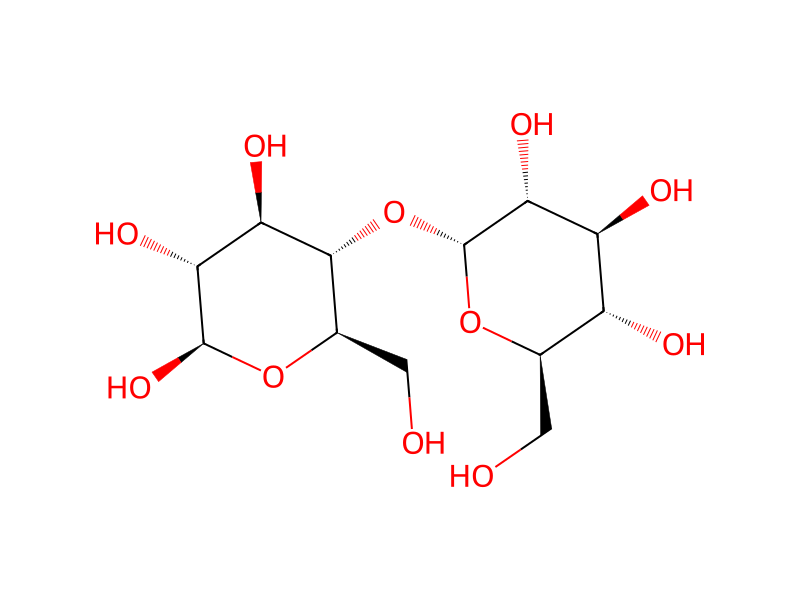

Product 1

Procedure
The maltitol-rich fraction obtained in the above was treated in accordance with the above method for treating the trehalose-rich fraction to obtain a crystalline powder with a maltitol purity of about 93%, except that the maltitol-rich fraction was previously concentrated to give a concentration of about 80%. The yield of solid contents in the step was about 85%, d.s.b. Since the product shows substantially no reducibility, a sharpened sweetness, and a relatively-low-dental-caries-inducibility, it can be arbitrarily used in food products, cosmetics, and pharmaceuticals.
Workup
- additionabove was treated in accordance with the above method
Sources & evidence
- ORD record
- ord-7541c8a2652a4db6bb439aed71bcb142
- Source dataset
- uspto-grants-2001_03
- Patent number
- US06200783B1
Reaction notes
Loading…