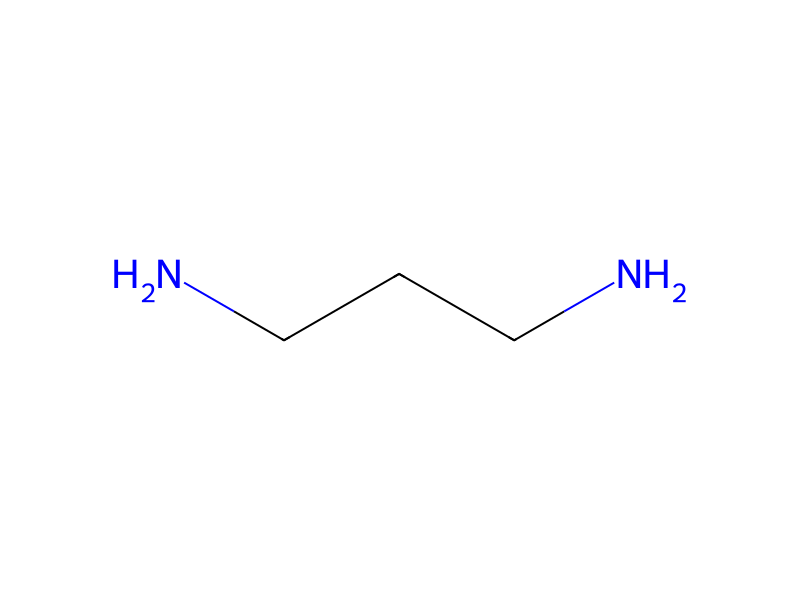
1,3-Propanediamine → HCID 21511922, compound
Reaction equation

ClC(Cl)(Cl)[C:3]([NH:5][C:6]1[CH:19]=[CH:18][C:17]([Cl:20])=[CH:16][C:7]=1[C:8]([C:10]1[CH:15]=[CH:14][CH:13]=[CH:12][CH:11]=1)=O)=[O:4].[NH2:23][CH2:24][CH2:25][CH2:26][NH2:27].O>C(O)C>[Cl:20][C:17]1[CH:18]=[CH:19][C:6]2[NH:5][C:3](=[O:4])[N:23]3[CH2:24][CH2:25][CH2:26][NH:27][C:8]3([C:10]3[CH:15]=[CH:14][CH:13]=[CH:12][CH:11]=3)[C:7]=2[CH:16]=1Participants
5
Reactant 3


Product 1

Reagents, catalysts & solvents 1

Procedure
To a solution of 1.89 g of 2-trichloroacetamido-5-chlorobenzophenone in 50 ml of ethanol was added 2.22 g of 1,3-diaminopropane, and the resultant mixture was allowed to stand at room temperature overnight. Then, the reaction mixture was poured into 300 ml of water, and the precipitate thus formed was separated by filtration, washed with ether and dried to give 1.25 g of 10-chloro-1,2,3,4,7,11b-hexahydro-11b-phenyl-6H-pyrimido[1,2-C]quinazolin-6-one, having a melting point of 275° - 276°C.
Workup
- customthe precipitate thus formed
- customwas separated by filtration
- washwashed with ether
- customdried
Sources & evidence
- ORD record
- ord-8c7287ff63484887b9ae3b07a10adfc0
- Source dataset
- uspto-grants-1976_09
- Patent number
- US03980645
Reaction notes
Loading…