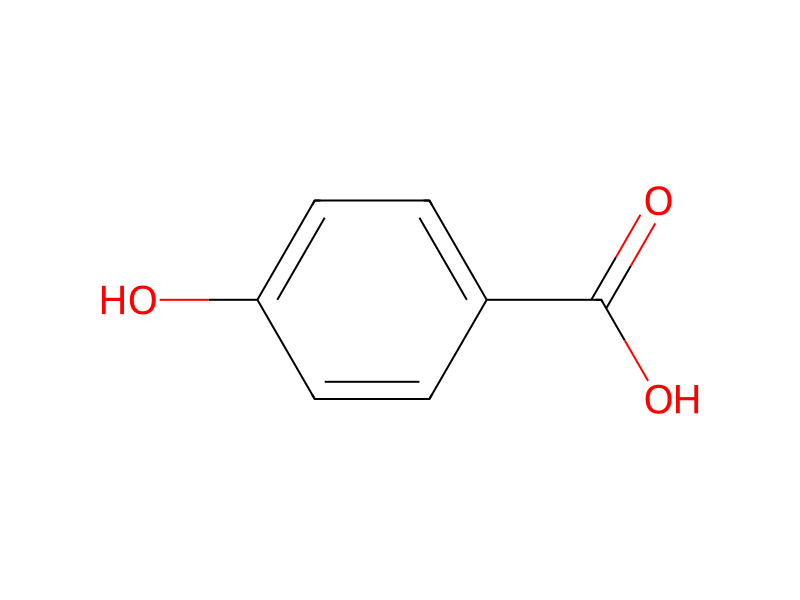
4-Hydroxybenzoic Acid → 3-Bromo-4-hydroxybenzoic acid
Reaction equation

[OH:1][C:2]1[CH:10]=[CH:9][C:5]([C:6]([OH:8])=[O:7])=[CH:4][CH:3]=1.[Br:11]Br.O>C(O)(=O)C>[Br:11][C:3]1[CH:4]=[C:5]([CH:9]=[CH:10][C:2]=1[OH:1])[C:6]([OH:8])=[O:7]Participants
Reactant 3


Product 1

Reagents, catalysts & solvents 1

Procedure
50 g (0.37 mol) of commercially available p-hydroxybenzoic acid was dissolved in 370 ml glacial acetic acid by heating with stirring. Heating was continued after the acid dissolved and 59 g (0.37 mol) bromine dissolved in 60 ml glacial acetic acid was rapidly added to the boiling solution to avoid bumping. The solution was refluxed for six hours with continuing stirring. Following reflux, the reaction solution was permitted to stand and cooled to room temperature. The cooled solution was poured into two liters of cold water. A white precipitate was formed. The white crystals were filtered by suction and were recrystalized with glacial acetic acid to yield 55.2 g of purified 3-bromo-4-hydroxybenzoic acid. The calculated yield was 70.3%.
Workup
- temperatureby heating
- temperatureHeating
- dissolutiondissolved
- additionwas rapidly added to the boiling solution
- temperatureThe solution was refluxed for six hours
- stirringwith continuing stirring
- temperatureFollowing reflux
- customA white precipitate was formed
- filtrationThe white crystals were filtered by suction
- customwere recrystalized with glacial acetic acid
Sources & evidence
- ORD record
- ord-dd802689f0164566bfe2c5ca966d1a83
- Source dataset
- uspto-grants-1981_09
- Patent number
- US04287085
Reaction notes
Loading…