Pyridine → HCID 21484429, compound
Reaction equation
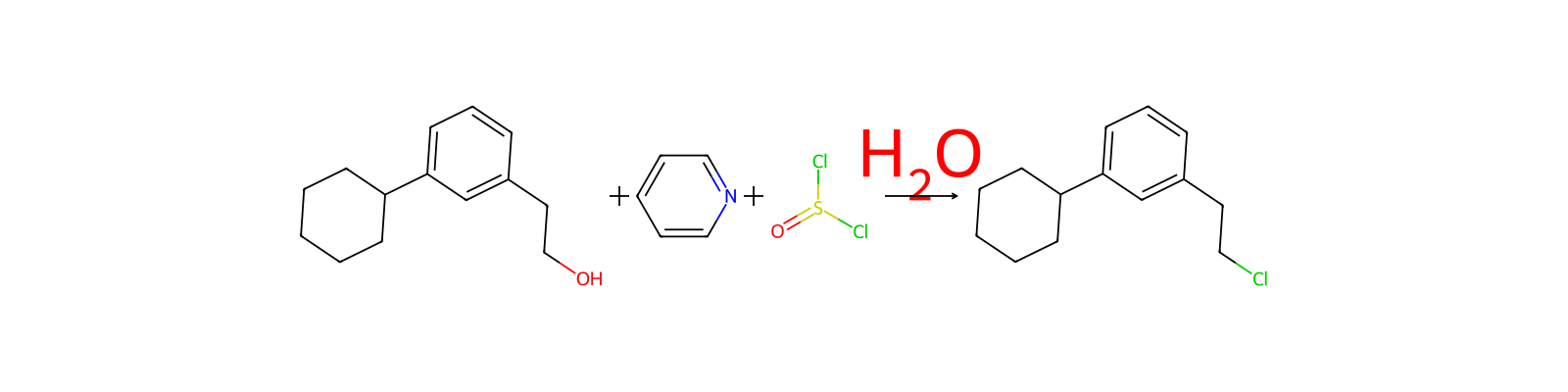
[CH:1]1([C:7]2[CH:8]=[C:9]([CH2:13][CH2:14]O)[CH:10]=[CH:11][CH:12]=2)[CH2:6][CH2:5][CH2:4][CH2:3][CH2:2]1.N1C=CC=CC=1.S(Cl)([Cl:24])=O>O>[CH:1]1([C:7]2[CH:8]=[C:9]([CH2:13][CH2:14][Cl:24])[CH:10]=[CH:11][CH:12]=2)[CH2:6][CH2:5][CH2:4][CH2:3][CH2:2]1Participants
Reactant 3



Product 1

Reagents, catalysts & solvents 1

Procedure
33.1 g of β-(m-cyclohexyl-phenyl)-ethanol are mixed with 13.3 ml of absolute pyridine. 12.5 ml of thionyl chloride are added dropwise to this mixture, whilst cooling with ice. Thereafter the reaction mixture is slowly heated to 100°-110°C and is kept at this temperature for 2 hours. The reaction solution is again cooled to room temperature, 29 ml of water are added and the whole is extracted with a mixture of ether and chloroform. The organic phase is washed twice with 2 N sodium carbonate solution, three times with 2 N hydrochloric acid and finally once with 2 N sodium carbonate solution, dried over sodium sulphate, filtered and evaporated. The residue, a brown oil, is distilled in a high vacuum. Hereupon, β-(m-cyclohexyl-phenyl)-ethyl chloride is obtained as a light yellow oil of boiling point 103°-8°C/0.1 mm Hg.
Workup
- temperaturewhilst cooling with ice
- temperatureThereafter the reaction mixture is slowly heated to 100°-110°C
- extractionthe whole is extracted with a mixture of ether and chloroform
- washThe organic phase is washed twice with 2 N sodium carbonate solution, three times with 2 N hydrochloric acid and finally once with 2 N sodium carbonate solution
- dry with materialdried over sodium sulphate
- filtrationfiltered
- customevaporated
- distillationThe residue, a brown oil, is distilled in a high vacuum
Sources & evidence
- ORD record
- ord-4c7833b96e6c4ea5949923b41a2ddc39
- Source dataset
- uspto-grants-1976_02
- Patent number
- US03940434
Reaction notes
Loading…