Hexachlorocyclopentadiene → 1,2,3,4,5-Pentachloro-5-ethylcyclopentadiene
Reaction equation

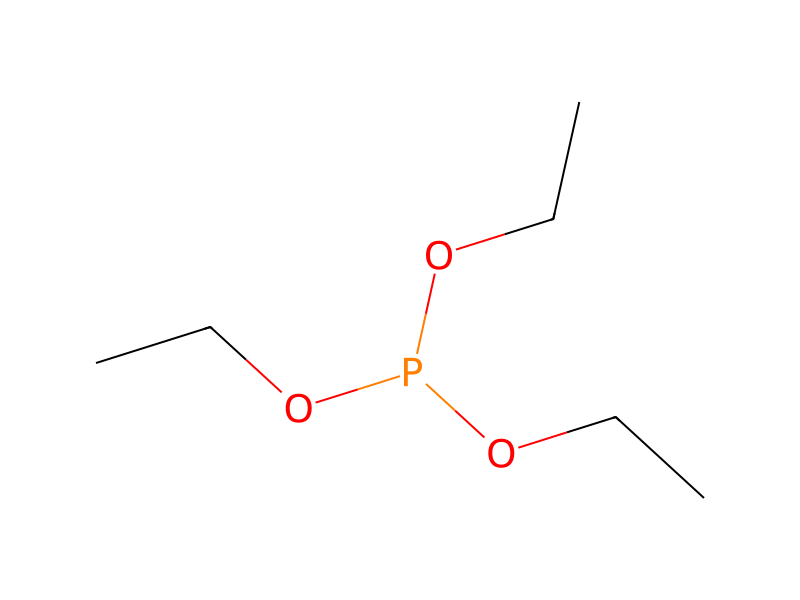
Cl[C:2]1([Cl:11])[C:6]([Cl:7])=[C:5]([Cl:8])[C:4]([Cl:9])=[C:3]1[Cl:10].P(OCC)(OCC)O[CH2:14][CH3:15].P(Cl)(=O)([O-])OCC>>[Cl:10][C:3]1[C:2]([Cl:11])([CH2:14][CH3:15])[C:6]([Cl:7])=[C:5]([Cl:8])[C:4]=1[Cl:9]Participants



Procedure
A solution of 272.8 g. (1.0 mole) of hexachlorocyclopentadiene in 300 ml. of petroleum ether (pentane range) was charged to a 2 liter 3 neck flask equipped with stirrer, thermometer, dropping funnel and an exit line protected with a drying tube. The flask was immersed in ice-water and triethyl phosphite (182.8 g., 1.1 mole) was added slowly from the dropping funnel at such a rate that the temperature of the reaction mixture did not exceed +15°C. After the addition was completed (which required 5 hours) the clear, brown solution was, after the stripping of the solvent, fractionated in vacuum through a 20 inch column, filled with glass helices. A lower boiling fraction, 161 g., b.p. 39°C. at 0.4 mm., nD25 1.4253 consisted of pure ethyl phosphorochloridate, Cl(EtO)2PO, which, accordingly, was obtained in 93.4% yield. Then the temperature rose fast in the column and a pale yellow oil distilled over sharply at 50°C. and 0.18 mm. Infrared and elemental analyses indicated that the yellow oil, nD25 1.5394, is pure 1,2,3,4,5-pentachloro-5-ethylcyclopentadiene.
Workup
- customequipped with stirrer
- customan exit line protected with a drying tube
- customdid not exceed +15°C
- additionAfter the addition
- custom5 hours
- additionfilled with glass helices
- customaccordingly, was obtained in 93.4% yield
- distillationa pale yellow oil distilled over sharply at 50°C.
Sources & evidence
- ORD record
- ord-0c8cf2c9bee743488e6c40daa22aa43e
- Source dataset
- uspto-grants-1976_01
- Patent number
- US03933922
Reaction notes
Loading…