3H-Indolium, 1,2,3,3-tetramethyl-, iodide (1:1) → N,N'-Diphenylformamidine
反応式

[I-].C[N+:3]1[C:11]2[C:6](=[CH:7][CH:8]=[CH:9][CH:10]=2)C(C)(C)[C:4]=1C>C(OC(=O)C)(=O)C.C(O)(=O)C>[C:11]1([NH:3][CH:4]=[N:3][C:11]2[CH:10]=[CH:9][CH:8]=[CH:7][CH:6]=2)[CH:6]=[CH:7][CH:8]=[CH:9][CH:10]=1参加物


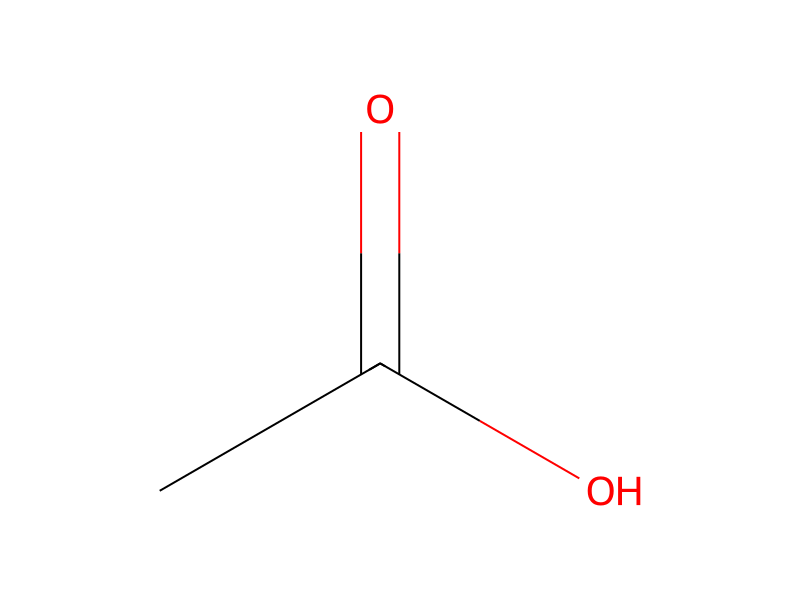
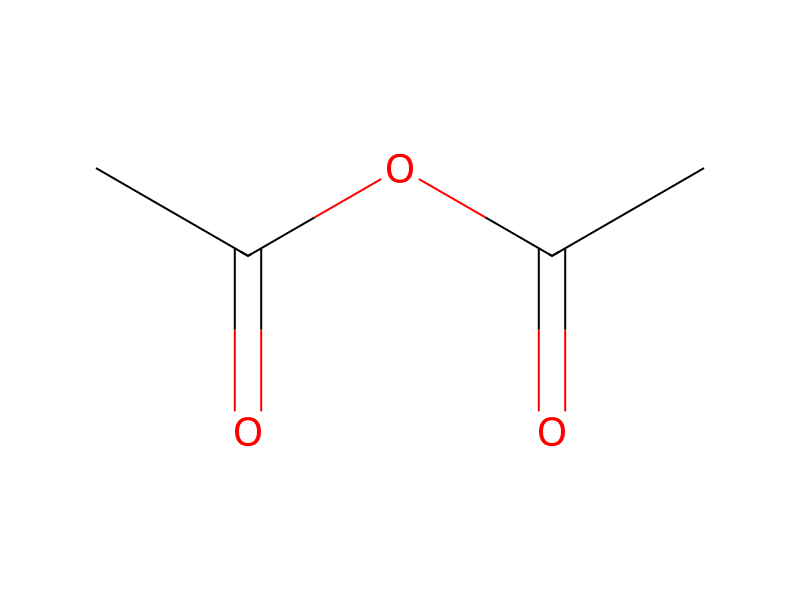
実験手順
Unfortunately, the hemicyanine intermediates are notoriously difficult to obtain in good yields and/or in a pure form. For example, the condensation of N-methyl-2,3,3-trimethyl[3H]indolium iodide with malonaldehyde dianil monochloride in acetic anhydride is said (Piggott and Rodd, BP 355,693/1930) to give rise to a green intermediate, indicating a strong contamination of the desired, yellow hemicyanine intermediate (yellow) with symmetric, blue indocyanine dye, FIG. 2. Moreover, when F. M. Hamer, in “Some Unsymmetrical Pentamethincyanine Dyes and their Tetramethin Intermediates” tried to prepare a pure sample of the same hemicyanine intermediate, obtained it in an 8% yield, after a lengthy and wasteful procedure based on multiple extractions and precipitations. More recently, R. B. Mujumdar, L. A. Ernst, Swati R. Mujumdar, C. J. Lewis, and A. S. Waggoner, in “Cyanine Dye Labelling Reagents: Sulfoindocyanine Succinimidyl Esters”, Bioconjugate Chemistry, 4, 105, (1993) described the synthesis of hemicyanine intermediates for the preparation of sulfoindocyanine dyes active esters, useful as labelling reagents. One intermediate was obtained by condensing 1-ethyl-2,3,3-trimethyl[3H]indolium-5-sulfonate with N,N′-diphenylformamidine in acetic acid for four hours. While the reported yield of the crude compound was 30%, the carboindocyanine dyes prepared from it were obtained only in 25% and 5% yields, after extensive purification by reverse phase HPLC chromatography. Similarly, the condensation of 1-ethyl-2,3,3-trimethyl[3H]indolium-5-sulfonate with malonaldehyde dianil hydrochloride in a mixture of acetic acid and acetic anhydride at reflux for four hours was said to produce the corresponding hemicyanine intermediate in an unreported yield. Again, the yields of the dicarboindocyanine dyes obtained from these intermediates were very low (5%). In fact, when Mank (Anal. Chem., 67, 1744) tried to synthesise the same dicarbocyanine label described in the previous reference he obtained a total yield of 18% of dicarbocyanines, from which the desired product was difficult to separate. He then devised an alternative approach based on 1,3,3-trimethoxypropene. Unfortunately, this chemical is no longer available commercially. Similar difficulties were encountered by us when trying to repeat the syntheses indicated above.
後処理
- customto obtain
- customin good yields
- customto give rise to a green intermediate
- customobtained it in an 8% yield
- extractionafter a lengthy and wasteful procedure based on multiple extractions and precipitations
- customthe synthesis of hemicyanine intermediates
出典と根拠
- ORDレコード
- ord-e8f74b4746b743218b5f41926ad4b322
- 出典データセット
- uspto-grants-2004_05
- 特許番号
- US06740755B2
反応ノート
読み込み中…