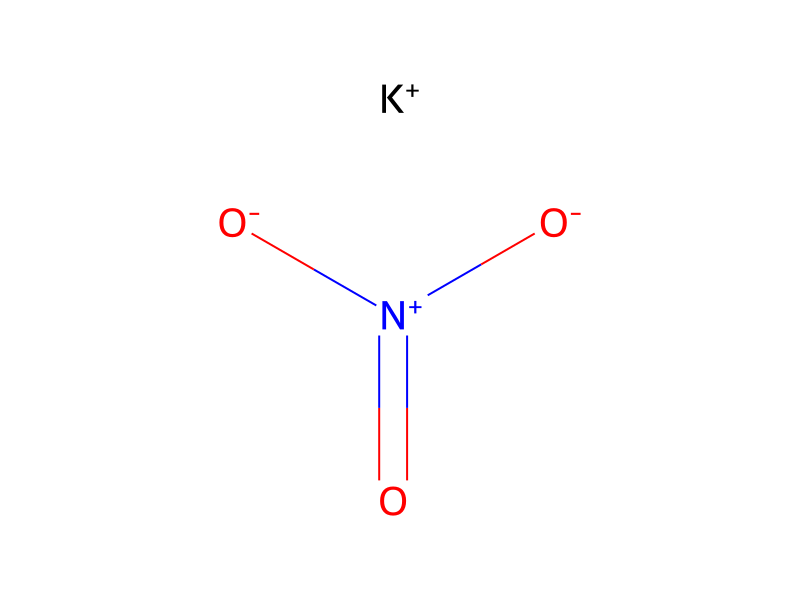
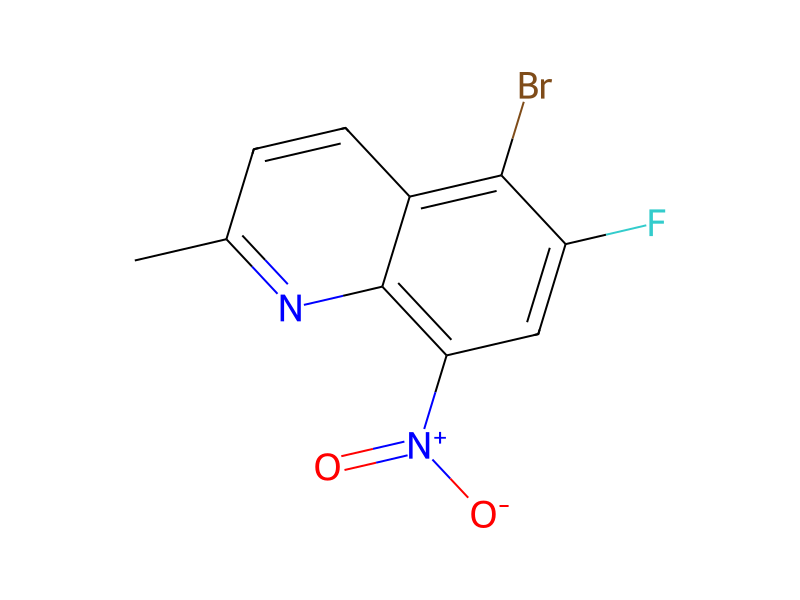
Potassium Nitrate → 5-Bromo-6-fluoro-8-nitroquinaldine
Reaction equation

[N+:1]([O-:4])([O-])=[O:2].[K+].[Br:6][C:7]1[C:16]([F:17])=[CH:15][CH:14]=[C:13]2[C:8]=1[CH:9]=[CH:10][C:11]([CH3:18])=[N:12]2>S(=O)(=O)(O)O.ClCCl>[Br:6][C:7]1[C:16]([F:17])=[CH:15][C:14]([N+:1]([O-:4])=[O:2])=[C:13]2[C:8]=1[CH:9]=[CH:10][C:11]([CH3:18])=[N:12]2Participants
5
Reactant 2

Product 1
Reagents, catalysts & solvents 2


Procedure
A solution of 11.5 g of potassium nitrate in 30 ml of concentrated sulfuric acid was added to 21.0 g of 5-bromo-6-fluoroquinaldine in 117 ml of concentrated sulfuric acid dropwise at -5° C. After stirring at room temperature for 5 hours, the reaction mixture was poured into 2 l of ice water to precipitate solids which were then collected by filtration. The filtrate was rendered alkaline to form a small amount of solids, which together with the former solids were dissolved in dichloromethane. After the solution was dried over sodium sulfate the solvent was distilled off. Recrystallization of the residue from isopaopanol gave 22.9 g of 5-bromo-6-fluoro-8-nitroquinaldine. m.p. 135°-137° C.
Workup
- customto precipitate solids which
- filtrationwere then collected by filtration
- customto form a small amount of solids, which together with the former solids
- dry with materialAfter the solution was dried over sodium sulfate the solvent
- distillationwas distilled off
- customRecrystallization of the residue from isopaopanol
Sources & evidence
- ORD record
- ord-3b348d87d0964ae488d9e0f91816ae67
- Source dataset
- uspto-grants-1985_11
- Patent number
- US04552879
Reaction notes
Loading…