1H-Isoindole-1,3(2H)-dione, 2-(2-bromoethyl)- → Diallyl 2-[2-(1,3-dioxoisoindolin-2-yl)ethyl]propanedioate
Reaction equation

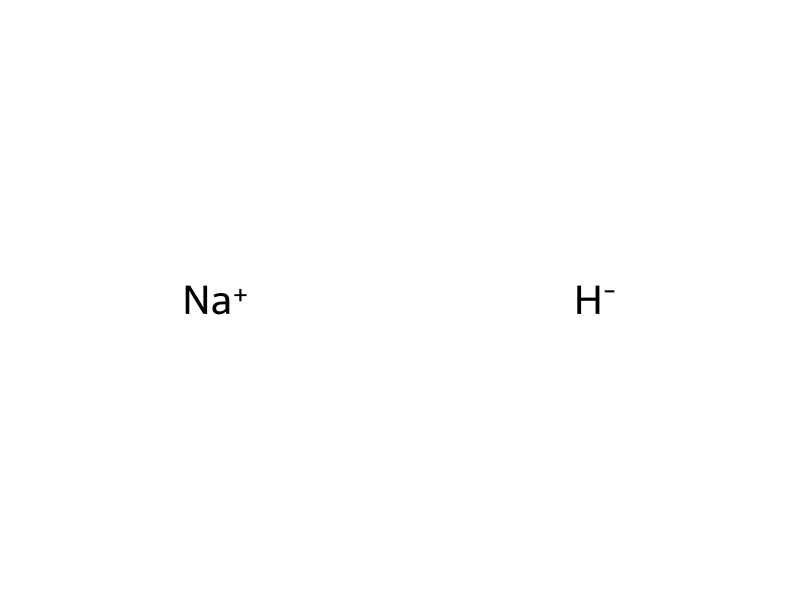
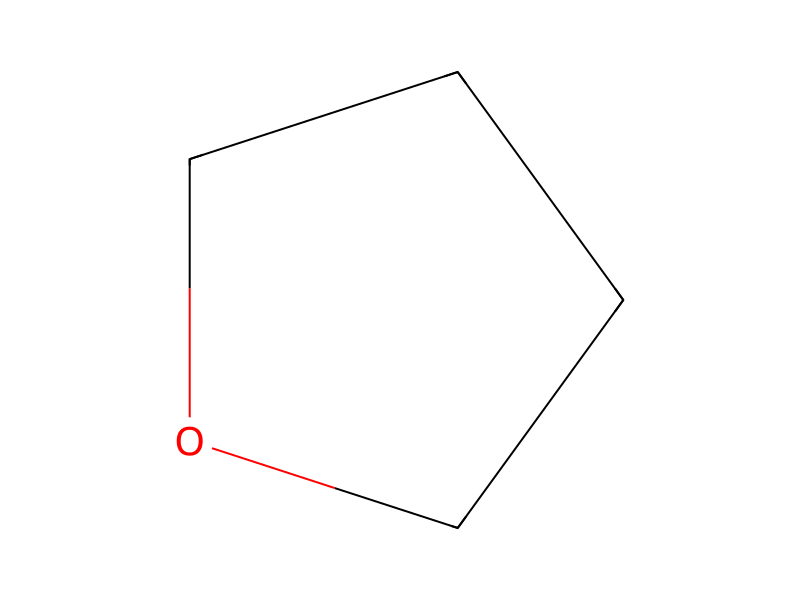
[H-].[Na+].[C:3]([O:12][CH2:13][CH:14]=[CH2:15])(=[O:11])[CH2:4][C:5]([O:7][CH2:8][CH:9]=[CH2:10])=[O:6].Br[CH2:17][CH2:18][N:19]1[C:23](=[O:24])[C:22]2=[CH:25][CH:26]=[CH:27][CH:28]=[C:21]2[C:20]1=[O:29]>C1COCC1>[C:20]1(=[O:29])[N:19]([CH2:18][CH2:17][CH:4]([C:5]([O:7][CH2:8][CH:9]=[CH2:10])=[O:6])[C:3]([O:12][CH2:13][CH:14]=[CH2:15])=[O:11])[C:23](=[O:24])[C:22]2=[CH:25][CH:26]=[CH:27][CH:28]=[C:21]12Participants



Procedure
Step 1 A solution of sodium hydride (4.35 g, 181 mmol) in freshly distilled THF (100 mL) was cooled to 0° C. and treated with commercially available diallyl malonate (35.0 g, 190 mmol) over 40 min via a dropping funnel. After stirring at room temperature for 30 min, N-(2-bromoethyl)phthalimide (43.9 g, 247 mmol) was added to the solution in one portion and the mixture was heated at reflux. After 48 h the solution was cooled to 0° C., quenched with 2N HCl and concentrated to about 20% of its original volume. The concentrate was diluted with ethyl acetate (300 mL) and washed successively with saturated aqueous solutions of K2CO3 and NaCl. The organic layer was dried over MgSO4, filtered and concentrated under reduced pressure. Purification by flash column chromatography (gradient elution with 5-25% ethyl acetate-hexanes) provided diallyl 2-phthalimidoethylmalonate (451.2 g, 64%) as a colorless oil. 1H NMR (300 MHZ, CDCl3) δ 7.82 (m, 2H), 7.72 (m, 2H), 5.85 (m, 2H), 5.30 (m, 2H), 5.22 (m, 2H), 4.60 (m, 4H), 3.80 (t, J=6.6 Hz, 2H), 346 (t, J=7.2 Hz, 1H), 2.30 (dd, J=13.8, 6.9 Hz, 2H). The product of the above-described reaction is illustrated below: ##STR30## Step 2. A one-necked, 50-mL, round-bottomed flask equipped with a rubber septum and an argon needle inlet was charged with 12 mL THF, trimethylsilyl chloride (0.83 ml, 0.710 g, 6.54 mmol), lithium hexamethyldisilazide (6.50 ml, 1.0 M in THF, 6.50 mmol), and cooled to -78° C. while a solution of 2-dodecanone (1.19 g, 6.46 mmol) in 8.0 ml THF was added dropwise over a period of 30 min via cannula. The resulting mixture was stirred at -78° C. for 30 min. N-bromosuccinimide (1.27 g, 7.13 mmol) was added, and the reaction mixture was stirred at -78° C. for 30 min, diluted with 200 ml of pentane, and washed with three 50 mL portions of brine. The organic phase was dried over Na2SO4 and concentrated to provide 2.5 g of a yellow solid. Column chromatography on 100 g of silica gel (gradient elution with 3-5% ethyl acetate-hexanes) afforded 0.680 g (40%) of the bromomethyl ketone as a white solid. TLC (5% ethyl acetate-hexanes) Rf =0.4. The product of the above-described reaction is illustrated below: ##STR31## Step 3. A one-necked, 25-ml, round-bottomed flask equipped with a rubber septum and an argon needle inlet was charged with 3 ml of THF and the product of step 1 (314 mg, 0.978 mmol). The resulting mixture was cooled to 0° C. and sodium t-butoxide (88.0 mg, 97% pure, 0.888 mmol) was added. After 30 min, a solution of the product of step 2 (250 mg, 0.950 mmol) in 3 ml of THF was added dropwise via syringe. The resulting mixture was allowed to warm to room temperature and stirred for 16 h. The reaction mixture was diluted with 100 ml of CH2Cl2 and washed with three 30 ml portions of brine. The organic layer was dried over MgSO4 and concentrated. Column chromatography on 40 g silica gel (gradient elution with 10-30% ethyl acetate-hexanes) afforded 0.300 g (63%) of the desired product as a white solid. TLC (30% ethyl acetate-hexanes) Rf=0.5. The product of the above-described reaction is illustrated below: ##STR32## Step 4 Preparation of Example 1. A one-necked, 154-mL, round-bottomed flask equipped with a rubber septum and an argon needle inlet was charged with 2 mL of dioxane, the product of step 3 (300 mg, 0.556 mmol), pyrrolidine (0.12 ml, 0.102 g, 1.44 mmol), and tetrakis(triphenylphospine)palladium (10.0 mg, 0.0086 mmol). The resulting mixture was exposed to a slight vacuum to degas the solution and argon was reintroduced. The reaction mixture was stirred at room temperature for 12 h, the dioxane and pyrrolidine were removed in vacuo, and the residue was redissolved in 2 ml dioxane. The resulting mixture was exposed to a slight vacuum to degas the solution and argon was reintroduced. The reaction mixture was heated at 115° C. for 4 h, 85° C. for 12 h, and concentrated. Column chromatography on 10 g of silica gel (30% ethyl acetate-hexanes with 0.5% acetic acid) afforded 0.137 g (59%) of Example 1 as a white solid (MP 89-90° C.). The product of the above-described reaction is illustrated below: ##STR33##
Workup
- temperaturethe mixture was heated
- temperatureat reflux
- temperatureAfter 48 h the solution was cooled to 0° C.
- customquenched with 2N HCl
- concentrationconcentrated to about 20% of its original volume
- additionThe concentrate was diluted with ethyl acetate (300 mL)
- washwashed successively with saturated aqueous solutions of K2CO3 and NaCl
- dry with materialThe organic layer was dried over MgSO4
- filtrationfiltered
- concentrationconcentrated under reduced pressure
- customPurification
- washby flash column chromatography (gradient elution with 5-25% ethyl acetate-hexanes)
Sources & evidence
- ORD record
- ord-ecb65d512678411891bb139a9f36649a
- Source dataset
- uspto-grants-1999_08
- Patent number
- US05932577
Reaction notes
Loading…