1-(Phenylmethyl) (2S,4R)-4-hydroxy-1,2-pyrrolidinedicarboxylate → N-Carbobenzyloxy-4-keto-L-proline
Reaction equation

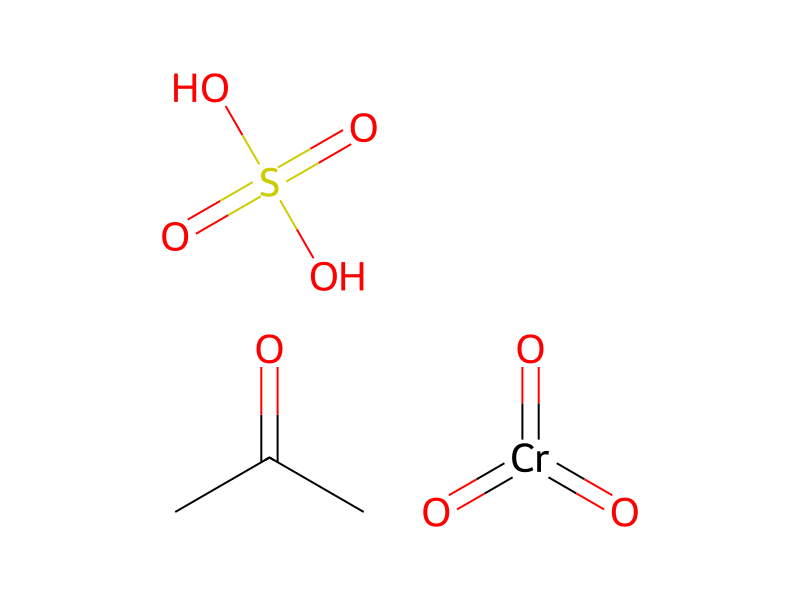
[C:1]([N:11]1[CH2:18][C@H:17]([OH:19])[CH2:16][C@H:12]1[C:13]([OH:15])=[O:14])([O:3][CH2:4][C:5]1[CH:10]=[CH:9][CH:8]=[CH:7][CH:6]=1)=[O:2].CC(C)=O.OS(O)(=O)=O.O=[Cr](=O)=O>CC(C)=O>[C:1]([N:11]1[CH2:18][C:17](=[O:19])[CH2:16][C@H:12]1[C:13]([OH:15])=[O:14])([O:3][CH2:4][C:5]1[CH:6]=[CH:7][CH:8]=[CH:9][CH:10]=1)=[O:2]Participants
Reactant 2

Product 1

Reagents, catalysts & solvents 1

Conditions
- Temperature
- -5 °C
Procedure
N-CBZ-trans-4-hydroxy-L-proline (2.65 g, 10.0 mmol) was dissolved in acetone (20 mL) and cooled to -5° C. in an ice-salt water bath. Jones reagent (7.5 mL, 20.0 mmol) was added, the ice bath was removed, and the reaction was stirred at room temperature for 2.25 h before quenching the excess Jones reagent with isopropanol (1 mL). After stirring for 2 h, the green solution was decanted from the dark green precipitate and concentrated in vacuo. The residue was partitioned between ethyl acetate (20 mL) and brine (10 mL). After separating the layers, the organic layer was washed once more with brine (10 mL) and the aqueous layer from this extraction was combined with that from the previous extraction. The total aqueous solution was washed with ethyl acetate (15 mL) and this organic layer combined with the previous one. Now the aforementioned dark green precipitate was dissolved in water (50 mL), saturated with NaCl, and extracted with ethyl acetate (5×10 mL). All organic layers were combined, dried (MgSO4), and concentrated in vacuo to yield the crude N-CBZ-4-keto-L-proline as a yellow oil, which was used without further purification. The ketone was dissolved in methanol (50 mL) and the reaction flask was cooled to 0° C. in an ice bath. A solution of NaBH4 (1.44 g, 38.0 mmol) in water (5 mL) was added dropwise. The reaction was allowed to sit in the refrigerator (-5° C.) for 20 h. Volatiles were removed in vacuo. The residue was diluted with H2O (10 mL) and acidified to pH 2-3 with concentrated HCl, then extracted with ethyl acetate (2×10 mL). The aqueous layer was saturated with NaCl and again extracted with ethyl acetate (2×10 mL). Now the aqueous layer was concentrated to a white solid, which was diluted with 2:1 ethyl acetate-THF (30 mL) and heated at mild reflux for 0.5 h. Salts were removed by filtration through celite. This filtrate and the organic layers from the previous extractions were combined, dried (MgSO4) and concentrated to yield the crude N-CBZ-cis-4-hydroxy-L-proline as a yellow oil. This residue was dissolved in ethanol (150 mL) containing a catalytic amount of p-toluenesulfonic acid monohydrate (0.25 g, 1.31 mmol). The reaction mixture was heated at reflux with the collection of wet ethanol in a Dean-Stark trap. After 36 h, the trap was emptied whenever full until the total reaction volume was about 50 mL. After neutralizing the tosic acid with NaHCO3 (0.5 g, 6.0 mmol), the solvent was removed in vacuo, the residue was diluted with ethyl acetate (75 mL) and the mixture stirred vigorously for 0.5 h to extract the product from the sodium salts. Solids were removed by filtration through Celite-K2CO3 and the filter cake was washed with ethyl acetate (15 mL). The combined filtrate and washings were concentrated. Purification of the resulting residue by flash chromatography (silica gel, using ethyl ether) provided the cis hydroxy ethyl ester (2.1 g, 83%) as a yellow oil: TLC Rf 0.18 (ethyl ether); 1H NMR (250 MHz, CDCl3) δ 7.37-7.27 (m, 5 H), 5.22-5.04 (m, 2 H, PhCH2), 4.50-4.35 (m, 2 H, H-2 and H-4), 4.25 (q, J=7.1 Hz, 1 H, CO2CH2CH3, one of two rotamers), 4.08 (app qd, J=7.1, 1.7 Hz, 1 H, CO2CH2CH3), 3.76-3.45 (m, 3 H, H-5 and OH), 2.41-2.26 (m, 1 H, H-3), 2.16-2.08 (m, 1 H, H-3), 1.30+1.14 (t, J=7.1 Hz, 3 H, CO2CH2CH3); IR (CHCl3) 3650-3250 (broad), 2990, 1735, 1705, 1420, 1355, 1200, 1125, 1080 cm1 ; LRMS (CI, 70 eV, isobutane) m/e 294 (M+, 100), 250 (34), 220 (9), 91 (29); HRMS (EI, 22 eV) m/e 293.1272 (293.1263 calcd for C15H19NO5).
Workup
- customthe ice bath was removed
- custombefore quenching the excess Jones reagent with isopropanol (1 mL)
- stirringAfter stirring for 2 h
- customthe green solution was decanted from the dark green precipitate
- concentrationconcentrated in vacuo
- customThe residue was partitioned between ethyl acetate (20 mL) and brine (10 mL)
- customAfter separating the layers
- washthe organic layer was washed once more with brine (10 mL)
- extractionthe aqueous layer from this extraction
- extractionfrom the previous extraction
- washThe total aqueous solution was washed with ethyl acetate (15 mL)
- dissolutionNow the aforementioned dark green precipitate was dissolved in water (50 mL), saturated with NaCl
- extractionextracted with ethyl acetate (5×10 mL)
- dry with materialdried (MgSO4)
- concentrationconcentrated in vacuo
Sources & evidence
- ORD record
- ord-a36df923742d42fe9f89a95c154fe6ca
- Source dataset
- uspto-grants-1999_08
- Patent number
- US05942537
Reaction notes
Loading…