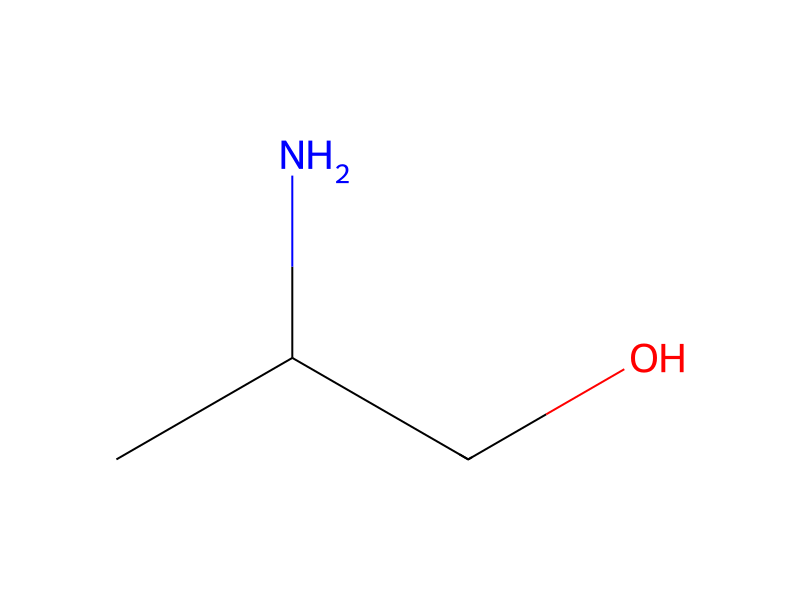
2-Aminopropanol → 2-[[6-[3-(Trifluoromethyl)phenyl]-3-pyridazinyl]amino]-1-propanol
Reaction equation

Cl[C:2]1[N:3]=[N:4][C:5]([C:8]2[CH:13]=[CH:12][CH:11]=[C:10]([C:14]([F:17])([F:16])[F:15])[CH:9]=2)=[CH:6][CH:7]=1.[NH2:18][CH:19]([CH3:22])[CH2:20][OH:21]>O>[F:15][C:14]([F:17])([F:16])[C:10]1[CH:9]=[C:8]([C:5]2[N:4]=[N:3][C:2]([NH:18][CH:19]([CH3:22])[CH2:20][OH:21])=[CH:7][CH:6]=2)[CH:13]=[CH:12][CH:11]=1Participants
4
Reactant 2

Product 1

Reagents, catalysts & solvents 1

Conditions
- Temperature
- 130 °C
Procedure
A mixture of 0.5 g of 3-chloro-6-[3-(trifluoromethyl)phenyl]pyridazine and 3 ml of 2-amino-1-propanol was heated at 130° C. for 24 hours, cooled and poured into water. The mixture was extracted with three 20 ml portions of dichloromethane. The combined extracts were washed with water, dried over magnesium sulfate and concentrated. The residual oil was dissolved in ethyl acetate and the solution passed through a short pad of silica gel. The filtrate was concentrated in vacuo and the residue was crystallized from dichloromethane-hexane to give 0.3 g of 2-[[6-[3-(trifluoromethyl)phenyl]-3-pyridazinyl]amino]-1-propanol as white crystals, mp 143°-144° C.
Workup
- temperaturecooled
- extractionThe mixture was extracted with three 20 ml portions of dichloromethane
- washThe combined extracts were washed with water
- dry with materialdried over magnesium sulfate
- concentrationconcentrated
- dissolutionThe residual oil was dissolved in ethyl acetate
- concentrationThe filtrate was concentrated in vacuo
- customthe residue was crystallized from dichloromethane-hexane
Sources & evidence
- ORD record
- ord-c67ee255125542b7bef92f122872e97e
- Source dataset
- uspto-grants-1986_02
- Patent number
- US04569934
Reaction notes
Loading…