Acryloyl chloride → HCID 13627534, compound
Reaction equation

[C:1]([C:3]1[C:8]([F:9])=[C:7]([F:10])[C:6]([OH:11])=[C:5]([F:12])[C:4]=1[F:13])#[N:2].[C:14](Cl)(=[O:17])[CH:15]=[CH2:16]>C(Cl)(Cl)(Cl)Cl>[C:14]([O:11][C:6]1[C:5]([F:12])=[C:4]([F:13])[C:3]([C:1]#[N:2])=[C:8]([F:9])[C:7]=1[F:10])(=[O:17])[CH:15]=[CH2:16]Participants
4
Reactant 2
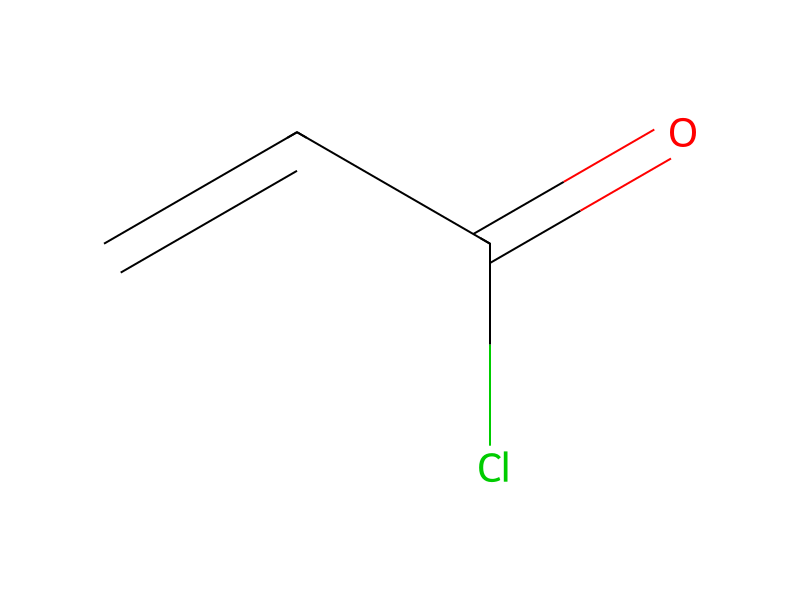

Product 1

Reagents, catalysts & solvents 1

Procedure
In 200 ml of carbon tetrachloride, 19.1 g (0.100 mol) of 4-cyano-2,3, 5,6-tetrafluorophenol and 11.3 g (0.125 mol) of acrylic acid chloride were dissolved. To the resultant solution, 20 g of molecular sieve 3 Å in diameter was added. The mixture was stirred under reflux for 38 hours. The resultant reaction mixture was cooled off and filtered to separate the molecular sieve. The filtrate was dried with magnesium sulfate and evaporated to dryness with a rotary evaporator. Consequently, there was obtained 15.2 g of 4-cyano-2,3,5,6-tetrafluorophenyl acrylate (yield 62.0% based on 4-cyano-2,3,5,6-tetrafluorophenol, purity 96.4%) having a melting point below determined.
Workup
- temperatureunder reflux for 38 hours
- customThe resultant reaction mixture
- temperaturewas cooled off
- filtrationfiltered
- customto separate the molecular sieve
- dry with materialThe filtrate was dried with magnesium sulfate
- customevaporated to dryness with a rotary evaporator
Sources & evidence
- ORD record
- ord-30b0eae3a0dd4aa8a2648f9d5e342602
- Source dataset
- uspto-grants-1986_02
- Patent number
- US04572805
Reaction notes
Loading…