Acetic Acid → 1-Acetyl-4-[2-(6-methyl-2-pyridyl)ethyl]piperazine
Reaction equation

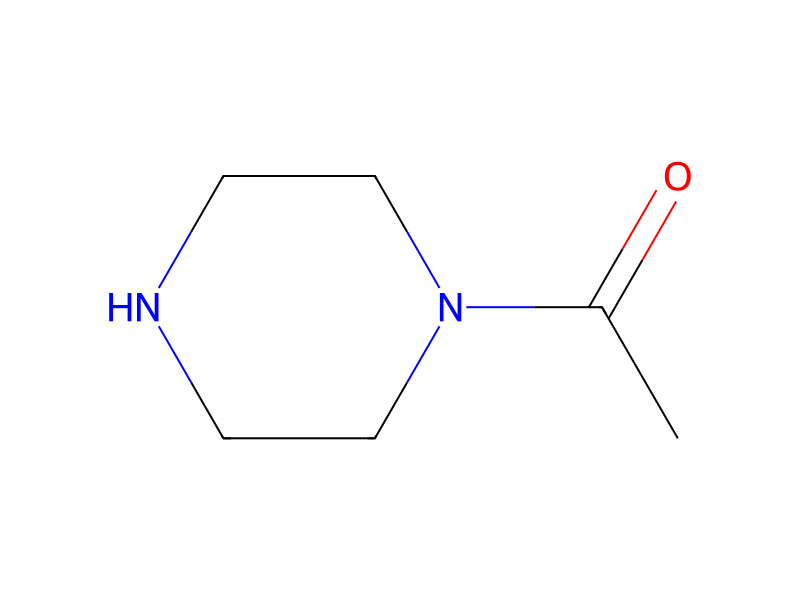
[C:1]([N:4]1[CH2:9][CH2:8][NH:7][CH2:6][CH2:5]1)(=[O:3])[CH3:2].[CH3:10][C:11]1[CH:16]=[CH:15][CH:14]=[C:13]([CH:17]=[CH2:18])[N:12]=1.C(O)(=O)C>CO>[C:1]([N:4]1[CH2:9][CH2:8][N:7]([CH2:18][CH2:17][C:13]2[CH:14]=[CH:15][CH:16]=[C:11]([CH3:10])[N:12]=2)[CH2:6][CH2:5]1)(=[O:3])[CH3:2]Participants
5
Reactant 3


Product 1

Reagents, catalysts & solvents 1

Conditions
- Temperature
- 80 °C
Procedure
To a stirring solution of N-acetylpiperazine (2.50 g, 20 mmol) in methanol (40 mL) at 0° C. under nitrogen was added 2-methyl-6-vinyl-pyridine (2.39 g, 20 mmol) and acetic acid (1.28 mL). The mixture was stirred for 24 hours at 80° C. and was then concentrated. The residue was partitioned between 10% aqueous K2CO3 /CH2Cl2. The organic phase was dried and concentrated to afford 3.60 g (73%) of 1-acetyl-4-[2-(6-methyl-2-pyridyl)ethyl]piperazine as a brown solid which was used directly in the next step: 1H NMR (CDCl3): δ7.48 (m, 1H), 7.0 (d, 1H), 3.63 (t, 2H), 3.45 (t, 2H), 2.95-2.60 (m, 4H), 2.50 (m, s, 9H), 2.08 (s, 3H).
Workup
- concentrationwas then concentrated
- customThe residue was partitioned between 10% aqueous K2CO3 /CH2Cl2
- customThe organic phase was dried
- concentrationconcentrated
Sources & evidence
- ORD record
- ord-a624e3182f434a17a02a92c71ad5b0ab
- Source dataset
- uspto-grants-1993_04
- Patent number
- US05202346
Reaction notes
Loading…