Uridine → Thymidine
Reaction equation

[C@@H:1]1(N2C=CC(N)=NC2=O)O[C@H](CO)[C@@H](O)[C@H]1O.[C@@H:18]1([N:27]2[CH:34]=[CH:33][C:31](=[O:32])[NH:30][C:28]2=[O:29])[O:26][C@H:23]([CH2:24][OH:25])[C@@H:21]([OH:22])[C@H:19]1O.[C@@H]1(N2C3N=C(N)NC(=O)C=3N=C2)O[C@H](CO)[C@@H](O)C1.[C@@H]1(N2C3N=C(N)NC(=O)C=3N=C2)O[C@H](CO)[C@@H](O)[C@H]1O>>[C@@H:18]1([N:27]2[CH:34]=[C:33]([CH3:1])[C:31](=[O:32])[NH:30][C:28]2=[O:29])[O:26][C@H:23]([CH2:24][OH:25])[C@@H:21]([OH:22])[CH2:19]1Participants


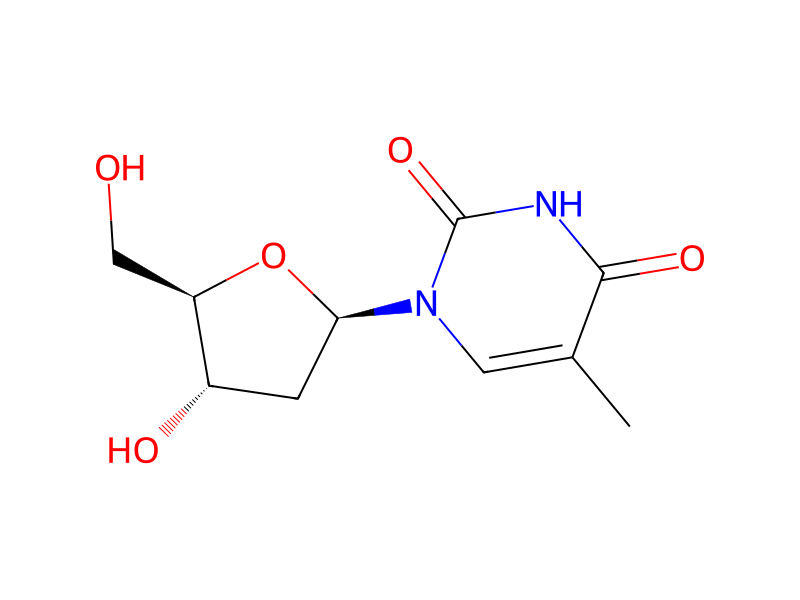
Procedure
Referring now to the drawing, FIG. 1 shows barley malt sprouts being fed to a dry mill 11, where they are ground to finer than 60 mesh, and normally 100 to 200 mesh (U.S. standard series mesh size). The ground sprouts in line 12 are admixed with an aqueous medium containing low levels of an activator (e.g., a metallic salt), and optionally, with recycled filtered liquor from line 17 to form a dispersion or mixture. Hydrolytic enzymes (e.g., pectinase, cellulase, hemicellulase, glucanase, etc.) may be added as processing aids to reduce the viscosity of the dispersion of barley malt sprouts, thereby allowing easier recovery of any thymidine in line 14. The resulting dispersion is heated and held at about 40° to 60° C. within kettle 15. The dispersion within kettle 15 is gently stirred continuously during the incubation period. The product which comprises crude liquor is then filtered in filter 16, and, as discussed above, some of the filtered liquor may be recycled or returned to feed line 12 by recycle line 17. Large molecular weight impurities are removed by filter 16 which can be either an ultrafiltration unit or a precipitator (e.g., to perform selective precipitation). The filtered liquor is sent to a solvent extraction unit or a unit containing an adsorption/desorption material on a suitable support in 18. A by-product of the solvent extraction process is removed from unit 18 by means of line 20. The resultant solvent extraction product from the filtered liquor yields thymidine and normally also contains other nucleosides, including cytidine, uridine, deoxy-guanosine and guanosine. The solvent extraction product on purified liquor is then sent via line 21 to a liquid chromatographic separator 22 to fractionate the nucleosides to obtain liquid thymidine. The liquid thymidine is then sent via line 23 to an evaporator 24 to concentrate the liquid thymidine. Evaporated liquid from the concentrated thymidine is removed from evaporator 24 via line 25. The concentrated thymidine is fed via line 26 to a crystallization unit 27. The crystalline thymidine is fed via line 28 to a dryer 29 and subsequently to packaging.
Workup
- extractionThe solvent extraction product
- customon purified liquor
Sources & evidence
- ORD record
- ord-d0d54c141c32483abce07773a708b811
- Source dataset
- uspto-grants-1993_04
- Patent number
- US05204245
Reaction notes
Loading…