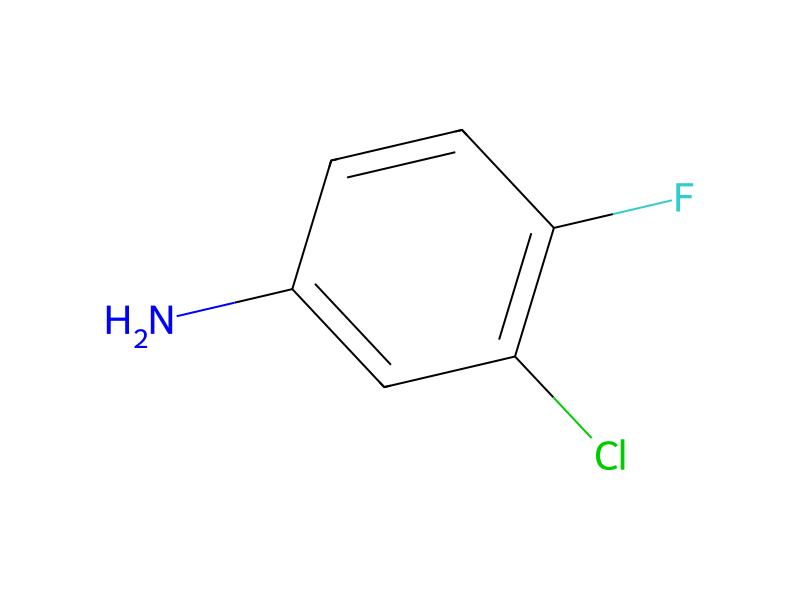
3-Chloro-4-fluoroaniline → HCID 21190629, compound
Reaction equation

Cl.C(OC1C=C2C(C([Cl:20])=NC=N2)=CC=1OC)C1C=CC=CC=1.[Cl:23][C:24]1[CH:25]=[C:26]([CH:28]=[CH:29][C:30]=1[F:31])[NH2:27]>>[ClH:20].[Cl:23][C:24]1[CH:25]=[C:26]([NH2:27])[CH:28]=[CH:29][C:30]=1[F:31]Participants


Procedure
Using 7-benzyloxy-4-chloro-6-methoxyquinazolin hydrochloride [described in Hennequin et al., J. Med. Chem. 1999, 42 (26), 5369-5389] and 3-chloro-4-fluoroaniline and in accordance with the above-mentioned method of Hennequin et al. or the method of Synthetic Example 13, the compound was converted to 7-benzyloxy-6-methoxy-4-quinazolinyl)-(3-chloro-4-fluorophenyl)amine hydrochloride (yield 83%). Trifluoroacetic acid (7 mL) was added to this compound (412 mg) and the mixture was heated under reflux for 90 min. After allowing to stand to cool, the reaction mixture was poured into ice water. The precipitate was collected by filtration, and the filtration residue was dissolved in methanol and dilute aqueous ammonia was added until alkalified. The precipitate was collected by filtration, washed with water and diethyl ether and dried under reduced pressure to give 4-(3-chloro-4-fluorophenylamino)-6-methoxyquinazolin-7-ol (quantitative). This compound was reacted in the same manner as in Synthetic Example 13-2). After the completion of the reaction, the reaction mixture was poured into 1N aqueous hydrochloric acid and extracted with ethyl acetate. The organic layer was washed with water, aqueous sodium hydrogen carbonate and saturated brine, and dried over anhydrous magnesium sulfate. The solvent was evaporated under reduced pressure. The residue was purified by silica gel column chromatography (hexane-ethyl acetate) to give the objective 7-triflate compound 6d (66%).
Sources & evidence
- ORD record
- ord-aa3b8356c60c4cd099bcf0b304b4e84d
- Source dataset
- uspto-grants-2007_11
- Patent number
- US07294629B2
Reaction notes
Loading…