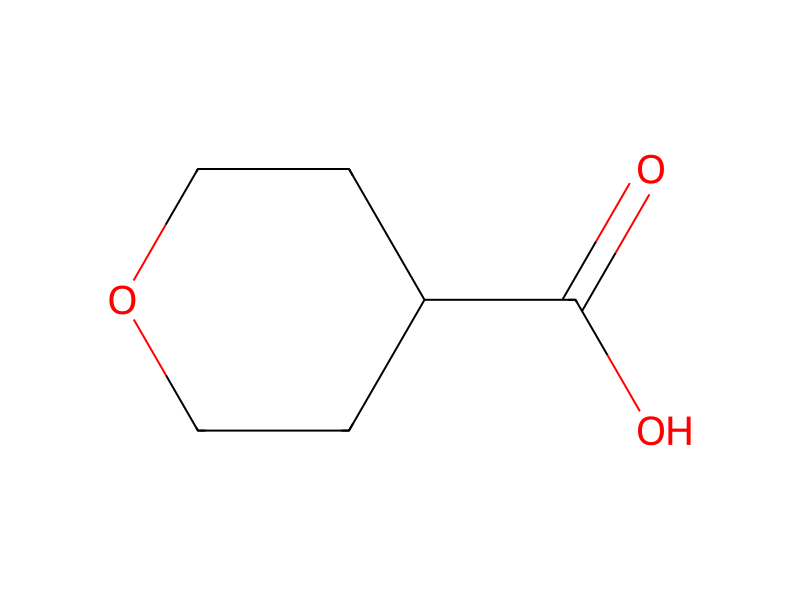
Hydrochloric Acid → Oxane-4-carboxylic acid
Reaction equation

[O:1]1[CH2:6][CH2:5][C:4](C(O)=O)([C:7]([OH:9])=[O:8])[CH2:3][CH2:2]1.N1C=CC=CC=1.O.Cl>[Fe].C(OCC)(=O)C>[O:1]1[CH2:6][CH2:5][CH:4]([C:7]([OH:9])=[O:8])[CH2:3][CH2:2]1Participants
Reactant 4




Product 1
Reagents, catalysts & solvents 2


Procedure
In a flask made of glass equipped with a stirring device, a thermometer and a reflux condenser and having an inner volume of 50 ml were charged, under nitrogen atmosphere, 1.0 g (5.74 mmol) of tetrahydropyran-4,4-dicarboxylic acid, 32 mg (0.57 mmol) of iron and 3.0 ml of pyridine, and the mixture was reacted at 110 to 120° C. for 1 hour under stirring. After completion of the reaction, the reaction mixture was cooled to room temperature, and 5 ml of water, 5 ml (60 mmol) of conc. hydrochloric acid and 10 ml of ethyl acetate were successively added in this order to the reaction mixture. The aqueous layer and the organic layer (the ethyl acetate layer) were separated, and the aqueous layer was washed three times with each 10 ml of ethyl acetate. Then, the organic layer and the ethyl acetate extracts were combined and concentrated under reduced pressure to give 548 mg (Isolation yield: 73%) of tetrahydropyran-4-carboxylic acid with purity of 100% (analytical value by differential refractometry) as white crystals.
Workup
- customIn a flask made of glass
- customequipped with a stirring device
- additionwere charged, under nitrogen atmosphere
- customAfter completion of the reaction
- customThe aqueous layer and the organic layer (the ethyl acetate layer) were separated
- washthe aqueous layer was washed three times with each 10 ml of ethyl acetate
- concentrationconcentrated under reduced pressure
Sources & evidence
- ORD record
- ord-277798cfc24b4ce3912095ebf1dc23e8
- Source dataset
- uspto-grants-2007_11
- Patent number
- US07300953B2
Reaction notes
Loading…