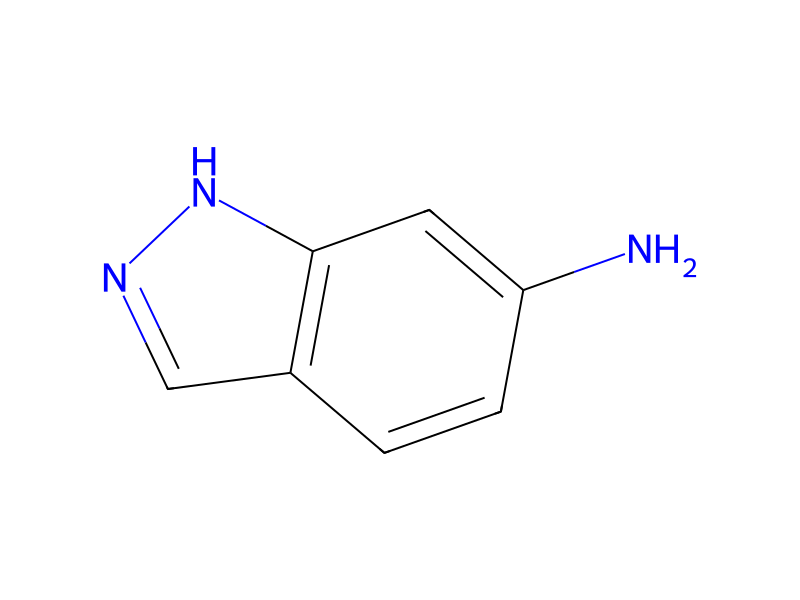
1H-Indazol-6-amine → 4-(1H-indazol-6-ylamino)-7-methoxy-quinoline-3-carbonitrile
Reaction equation

Cl[C:2]1[C:11]2[C:6](=[CH:7][C:8]([O:12][CH3:13])=[CH:9][CH:10]=2)[N:5]=[CH:4][C:3]=1[C:14]#[N:15].Cl.N1C=CC=CC=1.[NH2:23][C:24]1[CH:32]=[C:31]2[C:27]([CH:28]=[N:29][NH:30]2)=[CH:26][CH:25]=1>C(OCCO)C>[NH:30]1[C:31]2[C:27](=[CH:26][CH:25]=[C:24]([NH:23][C:2]3[C:11]4[C:6](=[CH:7][C:8]([O:12][CH3:13])=[CH:9][CH:10]=4)[N:5]=[CH:4][C:3]=3[C:14]#[N:15])[CH:32]=2)[CH:28]=[N:29]1Participants
5



Procedure
Using an analogous procedure to that described in Example 141, 200.0 mg (0.914 mmol) of 4-chloro-7-methoxy-3-quinolinecarbonitrile in 10 mL of 2-ethoxyethanol and in the presence of 105.6 mg (0.914 mmol) of pyridine hydrochloride was reacted with 147.8 mg (1.1 mmol) of 6-aminoindazole to give 280.0 mg (97.3%) of the product as a deep yellow solid, m.p.>250° C., mass (electrospray, m/e): M+H 315.9. HRCIMS: calcd 315.112 for C18H13N5O (M+), obsd 315.1124.
Sources & evidence
- ORD record
- ord-5ca7f6bbe11c46e7b2d9b1aa2a51ca11
- Source dataset
- uspto-grants-2001_09
- Patent number
- US06288082B1
Reaction notes
Loading…