1H-Indazol-6-amine → HCID 9922880, compound
Reaction equation

Cl[C:2]1[C:11]2[C:6](=[C:7]([O:12][CH3:13])[CH:8]=[CH:9][CH:10]=2)[N:5]=[CH:4][C:3]=1[C:14]#[N:15].[NH2:16][C:17]1[CH:25]=[C:24]2[C:20]([CH:21]=[N:22][NH:23]2)=[CH:19][CH:18]=1.Cl.N1C=CC=CC=1>C(OCCO)C>[NH:23]1[C:24]2[C:20](=[CH:19][CH:18]=[C:17]([NH:16][C:2]3[C:11]4[C:6](=[C:7]([O:12][CH3:13])[CH:8]=[CH:9][CH:10]=4)[N:5]=[CH:4][C:3]=3[C:14]#[N:15])[CH:25]=2)[CH:21]=[N:22]1Participants
5
Reactant 3
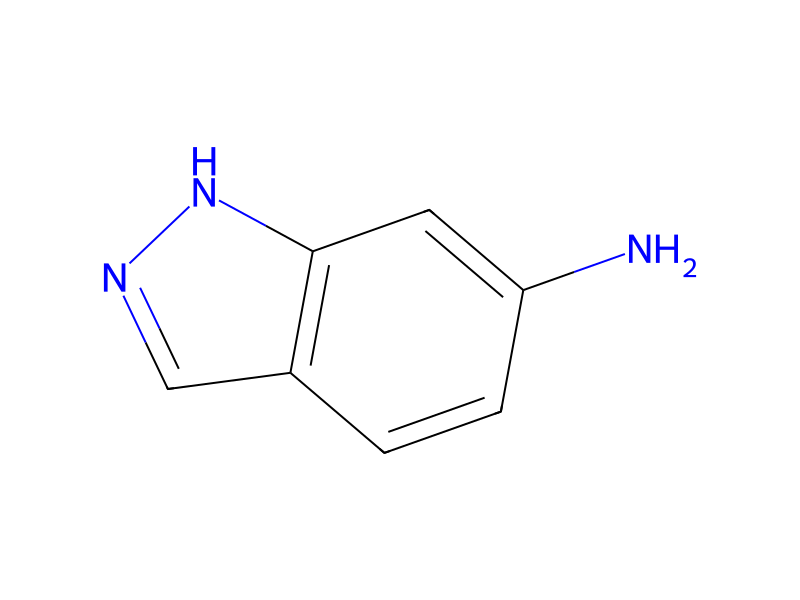


Product 1

Reagents, catalysts & solvents 1

Conditions
- Temperature
- 100 °C
Procedure
Using an analogous procedure to that described in Example 141, 328.0 mg (1.5 mmol) of 4-chloro-8-methoxy-3-quinolinecarbonitrile, 219.7 mg (1.65 mmol) of 6-aminoindazole and 105.6 mg (173.3 mmol) of pyridine hydrochloride in 15 mL of 2-ethoxyethanol was heated at 100° C. for 2 hr. The work up gave 373.8 mg (79%) of the product as a yellow solid, m.p. 242° C. (dec.), mass (electrospray, m/e): M+H 315.9. HRCIMS: calcd 315.112 for C18H13N5O (M+), obsd 315.1126.
Sources & evidence
- ORD record
- ord-bf3461277bbc4c0bb6623002185cfe3f
- Source dataset
- uspto-grants-2001_09
- Patent number
- US06288082B1
Reaction notes
Loading…