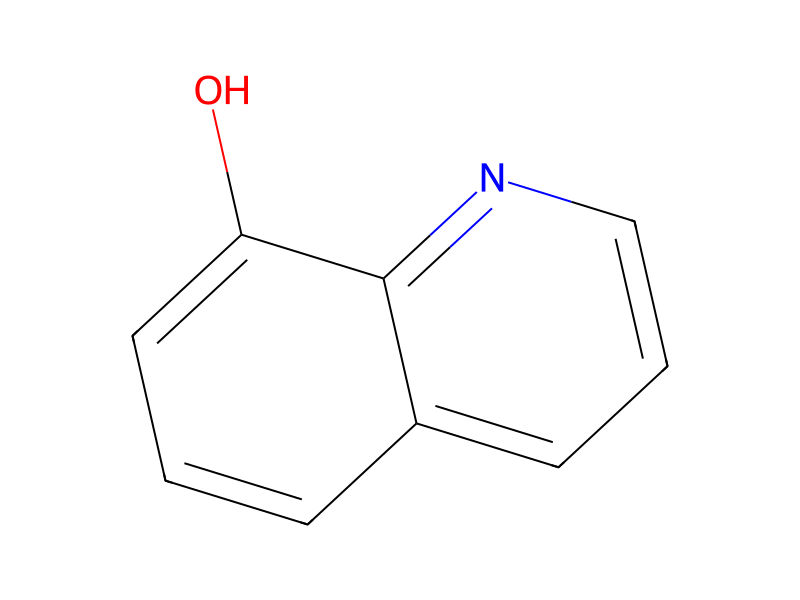
8-Hydroxyquinoline → 6-Chloro-2,3-dihydro-1h-indole
Reaction equation

Cl[C:2]1[CH:10]=[C:9]([Cl:11])[CH:8]=[CH:7][C:3]=1[CH2:4][CH2:5][NH2:6].OC1C=CC=C2C=1N=CC=C2.NN>C(O)CC(C)C>[Cl:11][C:9]1[CH:8]=[C:7]2[C:3]([CH2:4][CH2:5][NH:6]2)=[CH:2][CH:10]=1Participants
5
Reactant 3


Product 1

Reagents, catalysts & solvents 1

Procedure
This material was conveniently prepared on multigram scale from the cyclization of 2,4-dichlorophenethylamine in the presence of Na2 CO3 (s) (1.2 mol eq), Cu2Cl2 (0.01 mol eq) and 8-hydroxyquinoline (0.012 mol eq) in isoamyl alcohol (1 vol) at 130° C. for 5 hours. After addition of hydrazine (0.0055 vol) and 1 hour reflux, the mixture was filtered, solvent was removed in vacuo (45° C. @ ~10 mm Hg) and 6-chloro-indoline was obtained pure by vacuum distillation (95°-100° C. @ 2 mm Hg)(65-95%).
Workup
- temperaturereflux
- filtrationthe mixture was filtered
- customsolvent was removed in vacuo (45° C. @ ~10 mm Hg)
Sources & evidence
- ORD record
- ord-fd37b1ccb94c481097907e05c6204ecb
- Source dataset
- uspto-grants-1998_04
- Patent number
- US05736534
Reaction notes
Loading…