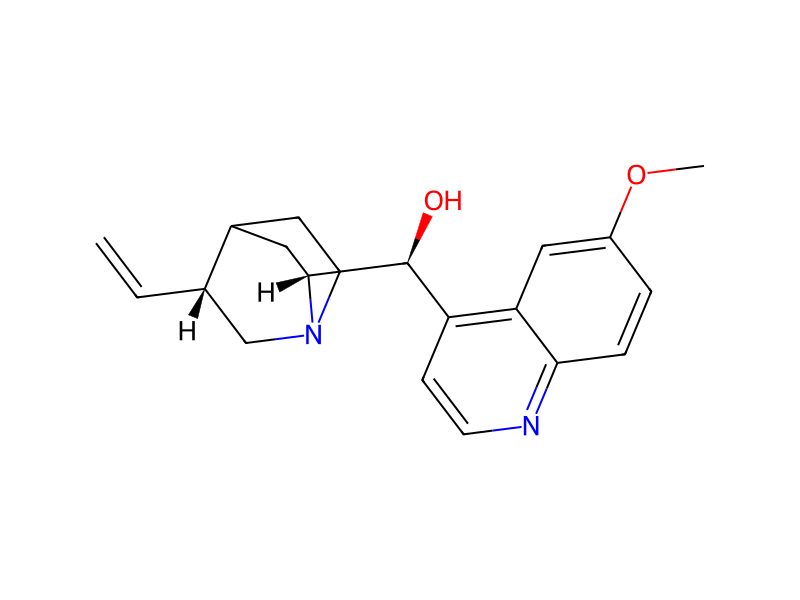
(S)-[(2R,5R)-5-ethenyl-1-azabicyclo[2.2.2]octan-2-yl]-(6-methoxyquinolin-4-yl)methanol → O-Desmethylquinidine
Reaction equation

C[O:2][C:3]1[CH:4]=[CH:5][C:6]2[N:12]=[CH:11][CH:10]=[C:9]([C@H:13]([OH:24])[C@@H:14]3[N:19]4[CH2:20][C@H:21]([CH:22]=[CH2:23])[CH:16]([CH2:17][CH2:18]4)[CH2:15]3)[C:7]=2[CH:8]=1.[OH-].[Na+]>ClCCl>[CH2:23]=[CH:22][CH:21]1[CH:16]2[CH2:15][CH:14]([C@H:13]([OH:24])[C:9]3[CH:10]=[CH:11][N:12]=[C:6]4[C:7]=3[CH:8]=[C:3]([OH:2])[CH:4]=[CH:5]4)[N:19]([CH2:18][CH2:17]2)[CH2:20]1Participants
Reactant 2

Product 1

Reagents, catalysts & solvents 1

Conditions
- Temperature
- -78 °C
Procedure
A 11 three-necked, round-bottom flask equipped with a condenser under argon atmosphere was charged with 5.0 g (15.4 mmol) of quinidine (97%, Aldrich) and 500 ml of dichloromethane. The solution in the flask was cooled to -78° C. To this cooled solution was slowly added 61 ml (61 mmol) of 1.0M borontribromide in dichloromethane over a period of 45 minutes. The reaction mixture was allowed to warm up to room temperature for a period of 2.5 h and was heated to reflux for 1 h. The reaction flask was cooled to -20° C. and 115 ml of 10% aqueous sodium hydroxide was slowly added. During the addition the temperature of the reaction mixture was maintained at 0° C. and was stirred vigorously. The mixture was transferred into a 21 separatory funnel. The remaining residue in the flask was transferred into the separatory funnel with the aid of a mixture of 5 ml of 10% sodium hydroxide and 20 ml of dichloromethane. The mixture in the separatory funnel, which contained some gummy yellow semi-solid, was shaken vigorously for 10 minutes and the aqueous layer was allowed to separate slowly from the organic phase. The organic layer was discarded and the aqueous phase was washed with 100 ml of dichloromethane and was cooled to 0° C. To the aqueous phase was added 12.5 ml of concentrated hydrochloric acid (HCl). This pH of this solution was adjusted to pH 10 with concentrated ammonium hydroxide. The resulting mixture was extracted with 12×250 ml of chloroform, dried with anhydrous sodium sulphate, concentrated and yielded 3.1 g of 6-hydroxycinchonine (1). The mother aqueous layer was extracted with 2×200 ml of n-butanol and yielded an additional 1.0 g to provide a total yield of 4.1 g of 6-hydroxycinchonine (1) (13.2 mmol, 86%). MS, IR and NMR data confirmed the identity of the compound.
Workup
- customA 11 three-necked, round-bottom flask equipped with a condenser under argon atmosphere
- customof 45 minutes
- temperatureto warm up to room temperature for a period of 2.5 h
- temperaturewas heated
- temperatureto reflux for 1 h
- temperatureThe reaction flask was cooled to -20° C.
- additionDuring the addition the temperature of the reaction mixture
- temperaturewas maintained at 0° C.
- stirringwas shaken vigorously for 10 minutes
- customto separate slowly from the organic phase
- washthe aqueous phase was washed with 100 ml of dichloromethane
- temperaturewas cooled to 0° C
- additionTo the aqueous phase was added 12.5 ml of concentrated hydrochloric acid (HCl)
- extractionThe resulting mixture was extracted with 12×250 ml of chloroform
- dry with materialdried with anhydrous sodium sulphate
- concentrationconcentrated
Sources & evidence
- ORD record
- ord-5e074faf5e2f442caab2688e3225a2a9
- Source dataset
- uspto-grants-1998_04
- Patent number
- US05741715
Reaction notes
Loading…