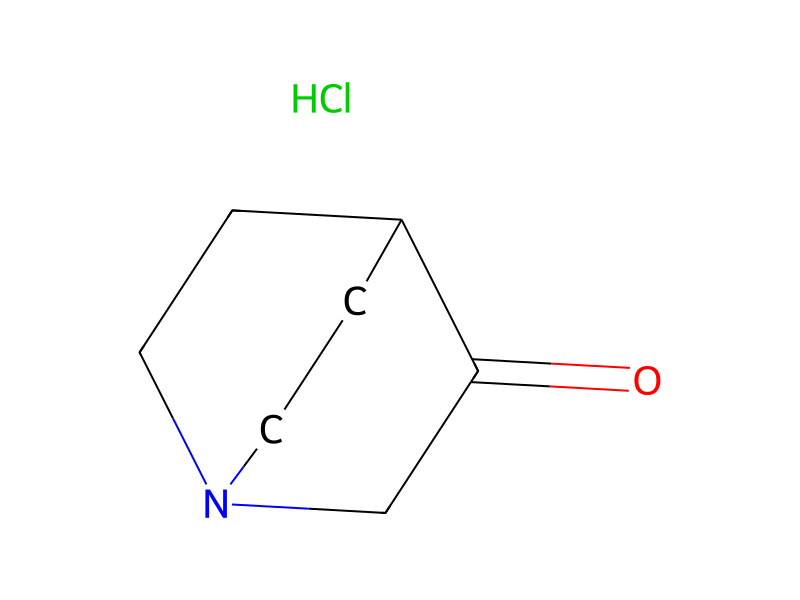
1-Azabicyclo(2.2.2)octan-3-one, hydrochloride (1:1) → 3-Quinuclidinol, (+)-
Reaction equation

Cl.[N:2]12[CH2:9][CH2:8][CH:5]([CH2:6][CH2:7]1)[C:4](=[O:10])[CH2:3]2>C1CC=CCCC=C1.C1CC=CCCC=C1.[Cl-].[Cl-].[Rh].[Rh].CO>[N:2]12[CH2:9][CH2:8][CH:5]([CH2:6][CH2:7]1)[C@H:4]([OH:10])[CH2:3]2Participants
Reactant 1
Product 1

Reagents, catalysts & solvents 2


Procedure
30.0 g (186 mmol) of 3-quinuclidinone hydrochloride, 18.3 mg (0.0371 mmol) of bis(1,5-cyclooctadiene)dirhodium(I) dichloride, 40.3 mg (0.0743 mmol) of (R)-1-[(S)-2-(diphenylphosphino)ferrocenyl]ethyl-di-tert-butylphosphine(IIIa, corresponding to an educt/catalyst molar ratio of 2500) and 300 ml of degassed methanol were introduced into an autoclave (450 ml) under argon. The reaction mixture was hydrogenated for 19 hours at 70° C.and 50 bar of H2. It was evaporated and the residue was dissolved in 250 ml of 2N hydrochloric acid. After extraction twice with 40 ml of dichloromethane, the pH was adjusted to 14 with sodium hydroxide solution (30 percent) and the mixture was evaporated. The residue was refluxed with350 ml of ethyl acetate and filtered off hot. The aqueous phase was separated off and the organic phase was evaporated. Recrystallization fromethyl acetate (150 ml) gave 22.3 (94 percent) of (S)-3-quinuclidinol with 24 percent ee. Other data concerning the product was:
Workup
- customIt was evaporated
- dissolutionthe residue was dissolved in 250 ml of 2N hydrochloric acid
- extractionAfter extraction twice with 40 ml of dichloromethane
- customthe mixture was evaporated
- temperatureThe residue was refluxed with350 ml of ethyl acetate
- filtrationfiltered off hot
- customThe aqueous phase was separated off
- customthe organic phase was evaporated
- customRecrystallization fromethyl acetate (150 ml)
Sources & evidence
- ORD record
- ord-510dab2455fa4a05967b0f4fc71ccc24
- Source dataset
- uspto-grants-1998_04
- Patent number
- US05744606
Reaction notes
Loading…