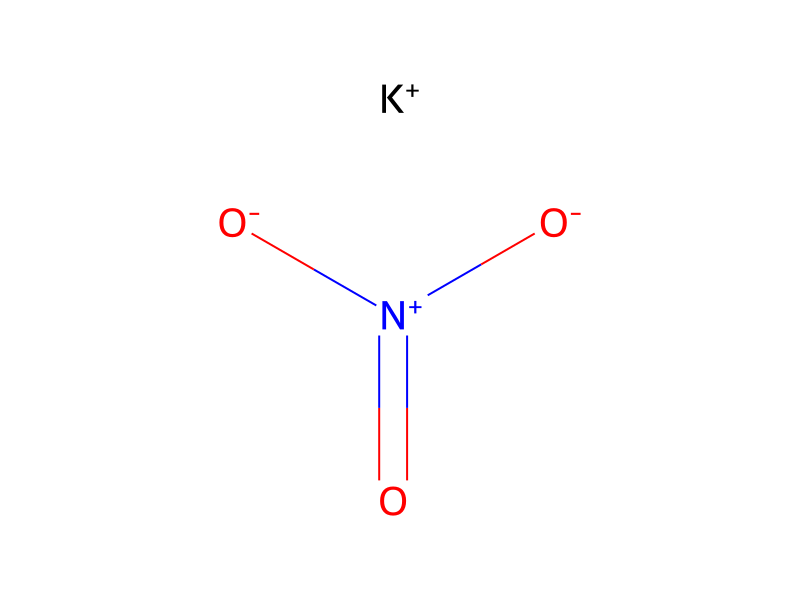
Potassium Nitrate → 7-Chloro-6,8-difluoro-5-nitro-1,4-dihydroquinoxaline-2,3-dione
Reaction equation

[Cl:1][C:2]1[C:3]([F:15])=[C:4]2[C:9](=[CH:10][C:11]=1[F:12])[NH:8][C:7](=[O:13])[C:6](=[O:14])[NH:5]2.[N+:16]([O-])([O-:18])=[O:17].[K+]>OS(O)(=O)=O>[Cl:1][C:2]1[C:3]([F:15])=[C:4]2[C:9]([NH:8][C:7](=[O:13])[C:6](=[O:14])[NH:5]2)=[C:10]([N+:16]([O-:18])=[O:17])[C:11]=1[F:12]Participants
4



Procedure
To a solution of 120 mg (5.16 mmol) of 6-chloro-5,7-difluoro-1,4-dihydroquinoxaline-2,3-dione in 1 mL of H2SO4 (97%) kept in an ice bath was added portionwise 60 mg (0.59 mmol) of KNO3. The solution was stirred at room temperature for 14 h and 60 mg of KNO3 was added. It was stirred at room temperature for 24 h, then diluted with ice-water (4 mL), filtered, washed with water, and dried to leave a yellow solid (94 mg, 65%). The solid was purified by NaOH/HCl precipitation to leave 63 mg of yellow solid; mp>250° C.; 1H NMR (DMSO-d6), 12.11 (mb, 1), 12.503 (s, 1).
Workup
- stirringIt was stirred at room temperature for 24 h
- filtrationfiltered
- washwashed with water
- customdried
Sources & evidence
- ORD record
- ord-9db58aa0f1e9412295194c3ce55e385f
- Source dataset
- uspto-grants-1999_11
- Patent number
- US05977107
Reaction notes
Loading…