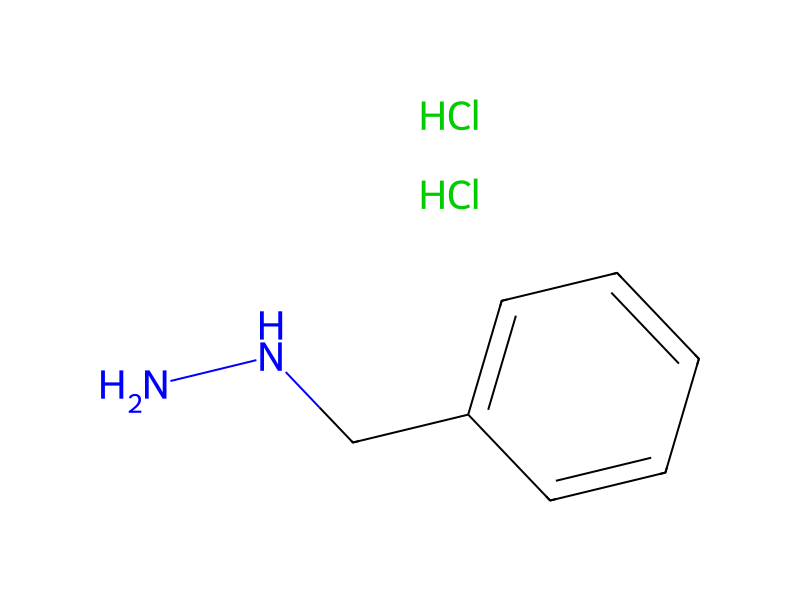
Benzylhydrazine dihydrochloride → HCID 10850983, compound
Reaction equation

C[O-].[Na+].Cl.Cl.[CH2:6]([NH:13][NH2:14])[C:7]1[CH:12]=[CH:11][CH:10]=[CH:9][CH:8]=1.[C:15]([C:17](=[C:20](SC)[NH:21][C:22]1[CH:27]=[CH:26][CH:25]=[CH:24][CH:23]=1)[C:18]#[N:19])#[N:16]>CO.C(O)C>[NH2:19][C:18]1[N:13]([CH2:6][C:7]2[CH:12]=[CH:11][CH:10]=[CH:9][CH:8]=2)[N:14]=[C:20]([NH:21][C:22]2[CH:23]=[CH:24][CH:25]=[CH:26][CH:27]=2)[C:17]=1[C:15]#[N:16]Participants
Reactant 3


Product 1

Reagents, catalysts & solvents 2


Procedure
With ice-cooling, 19.3 ml of a 5.4N sodium methanolate solution in 20 ml of methanol (purissimum) are added to 9.9 g of benzylhydrazine dihydrochloride in 20 ml of methanol (purissimum) and the reaction mixture is stirred for approx. 15 minutes at room temperature and then introduced into a solution of 4.65 g of 2-cyano-3-methylmercapto-3-phenylamino-acrylonitrile in 150 ml of absolute ethanol. The mixture is heated under reflux for approx. 17 hours and cooled to room temperature and insoluble material is filtered off with suction. The filtrate is concentrated by evaporation using a rotary evaporator and the brown oily residue is chromatographed on 190 g of silica gel, methylene chloride/ethyl acetate mixtures being used as eluant. 5-Amino-1-benzyl-4-cyano-3-phenylamino-pyrazole is obtained; m.p. 139-140° C., FAB-MS: (M+H)+ =290 (C17H15N5).
Workup
- temperatureWith ice-cooling
- temperatureThe mixture is heated
- temperatureunder reflux for approx. 17 hours
- temperaturecooled to room temperature
- filtrationinsoluble material is filtered off with suction
- concentrationThe filtrate is concentrated by evaporation
- customa rotary evaporator
- customthe brown oily residue is chromatographed on 190 g of silica gel, methylene chloride/ethyl acetate
Sources & evidence
- ORD record
- ord-320d861e0100417b9c10b5c40b874f19
- Source dataset
- uspto-grants-1999_11
- Patent number
- US05981533
Reaction notes
Loading…