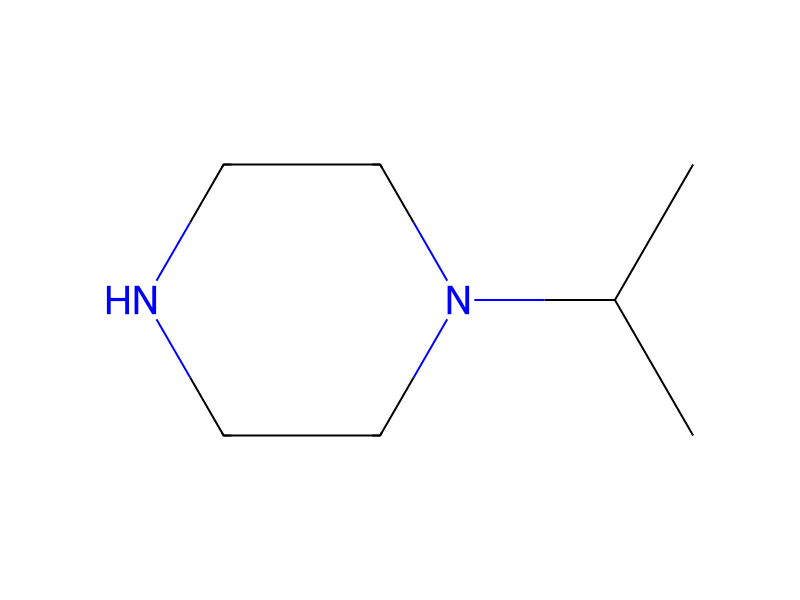
1-Isopropylpiperazine → HCID 21527086, compound
Reaction equation

[Cl:1][C:2]1[CH:3]=[CH:4][C:5]([N:8]2[CH:12]([O:13][C:14]([O:16]C3C=CC=CC=3)=O)[C:11]3[S:23][CH2:24][CH2:25][S:26][C:10]=3[C:9]2=[O:27])=[N:6][CH:7]=1.[CH:28]([N:31]1[CH2:36][CH2:35][NH:34][CH2:33][CH2:32]1)([CH3:30])[CH3:29]>C(#N)C>[Cl:1][C:2]1[CH:3]=[CH:4][C:5]([N:8]2[CH:12]([O:13][C:14]([N:34]3[CH2:35][CH2:36][N:31]([CH:28]([CH3:30])[CH3:29])[CH2:32][CH2:33]3)=[O:16])[C:11]3[S:23][CH2:24][CH2:25][S:26][C:10]=3[C:9]2=[O:27])=[N:6][CH:7]=1Participants
Reactant 2

Product 1

Reagents, catalysts & solvents 1

Conditions
- Temperature
- 2 °C
Procedure
6-(5-Chloropyrid-2-yl)-7-oxo-5-phenoxycarbonyloxy-2,3,6,7-tetrahydro-1,4-dithiino[2,3-c]pyrrole (10.0 g.) and 1-isopropylpiperazine (6.1 g.) in anhydrous acetonitrile (100 cc.) is stirred for 20 hours at a temperature of about 25° C. The reaction mixture is filtered and then evaporated under reduced pressure (20 mm. Hg). The residue is dissolved in methylene chloride (250 cc.). The organic solution is washed twice with N sodium hydroxide solution (total 160 cc.) and once with distilled water (80 cc.) and then evaporated. The residue is dissolved in an ice-cold 0.5N aqueous solution of methanesulphonic acid (200 cc.). The aqueous acid solution is washed twice with diethyl ether (total 100 cc.) and then rendered alkaline by adding 10N sodium hydroxide solution. The oil which separates out is extracted twice with methylene chloride (total 240 cc.). The organic solution is washed three times with distilled water (total 240 cc.) dried over anhydrous sodium sulphate, treated with decolourising charcoal (0.2 g.) and evaporated. The crystals obtained (10.3 g.; m.p. 130°-135° C.) are dissolved in boiling acetonitrile (26 cc.). After filtering the boiling solution and then cooling it for 2 hours at 2° C, the crystals which have appeared are filtered off, washed twice with ice-cold acetonitrile (total 15 cc.) and dried under reduced pressure (20 mm. Hg). 6-(5-Chloropyrid-2-yl)-5-(4-isopropylpiperazin-1-yl)carbonyloxy-7-oxo-2,3,6,7-tetrahydro-1,4-dithiino[2,3-c]pyrrole (6.9 g.), melting at 156° C, is thus obtained.
Workup
- filtrationThe reaction mixture is filtered
- customevaporated under reduced pressure (20 mm. Hg)
- dissolutionThe residue is dissolved in methylene chloride (250 cc.)
- washThe organic solution is washed twice with N sodium hydroxide solution (total 160 cc.) and once with distilled water (80 cc.)
- customevaporated
- dissolutionThe residue is dissolved in an ice-cold 0.5N aqueous solution of methanesulphonic acid (200 cc.)
- washThe aqueous acid solution is washed twice with diethyl ether (total 100 cc.)
- additionby adding 10N sodium hydroxide solution
- extractionThe oil which separates out is extracted twice with methylene chloride (total 240 cc.)
- washThe organic solution is washed three times with distilled water (total 240 cc.)
- dry with materialdried over anhydrous sodium sulphate
- additiontreated with decolourising charcoal (0.2 g.)
- customevaporated
- customThe crystals obtained (10.3 g.; m.p. 130°-135° C.)
- dissolutionare dissolved
- filtrationAfter filtering the boiling solution
- filtrationthe crystals which have appeared are filtered off
- washwashed twice with ice-cold acetonitrile (total 15 cc.)
- customdried under reduced pressure (20 mm. Hg)
Sources & evidence
- ORD record
- ord-69eea185498942d98ef3c1e676b745d5
- Source dataset
- uspto-grants-1976_04
- Patent number
- US03948917
Reaction notes
Loading…