HCID 86743378, compound → HCID 86743377, compound
Reaction equation

[S:1]([O:5][S:6]([O:9]S(O)(=O)=O)(=[O:8])=[O:7])([OH:4])(=[O:3])=[O:2].[OH:14][CH2:15][CH:16]([CH2:18][OH:19])[OH:17]>OCC(CO)O>[S:1]([O:5][S:6]([OH:9])(=[O:8])=[O:7])([OH:4])(=[O:3])=[O:2].[OH:14][CH2:15][CH:16]([CH2:18][OH:19])[OH:17]Participants
Reactant 1

Product 1

Reagents, catalysts & solvents 1
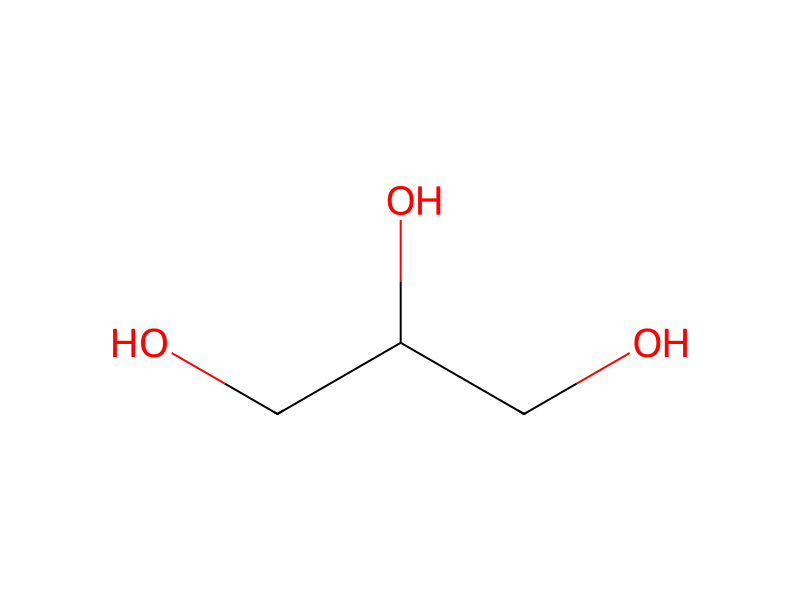
Procedure
In the drawing Stage 1 reactor 11 is the situs for sulfation of glycerol byoleum at a temperature of about 35° C. The glycerol trisulfuric acidresulting is fed via line 13 to Stage 2 reactor 15 wherein the glycerol trisulfuric acid is transesterified with triglyceride, at a temperature ofabout 50° C., producing monoesterified glycerol disulfuric acid (theso-called acid mix), which passes through line 17 to Stage 3 reactor 19. Insuch reactor the glycerol disulfuric acid monoester is neutralized with sodium hydroxide solution, producing sodium monoglyceride sulfate, accompanied by sodium sulfate byproduct and ether soluble organic matter (impurities), which includes unreacted glycerol, unreacted diglyceride, and fatty acid hydrolysis products of the triglyceride. Such materials arefed through line 21 to extractor 23, to which water and isopropanol are added. In the extractor the contents separate into two phases, with the lower aqueous phase containing most of the sodium sulfate dissolved therein and the upper aqueous alcoholic phase containing the monoglyceridesulfate and the lipophiles or ether solubles (which are also soluble in aqueous isopropanol), with some sodium sulfate. The upper phase solvent medium is about a 1:1 cosolvent solution of isopropanol and water but suchratio may be in the range of 2:1 to 1:2, preferably 3:2 to 2:3. After removal of the aqueous sodium sulfate phase the remaining aqueous isopropanol phase, containing the monoglyceride sulfate, is passed throughline 25 to dissolver (mixer) 27, to which kettle soap, in liquid state at elevated temperature, and fatty acids (which may be in solid state) are added. Alternatively, the fatty acid may be emulsified or dissolved first in the hot kettle soap and the emulsion or solution may then be dissolved in the aqueous isopropanol extractant medium, which also contains the monoglcyeride sulfate. The temperature in the dissolver will normally be in the range of about 50° to 90° C., e.g., about 60° C., and the various components will be perfectly dissolved in each other and in the aqueous isopropanol medium, with the total solids content normally being in the range of 45 to 65%, e.g., about 55%. The solution from the dissolver is then passed through line 29 to a wiped film dryer orevaporator, in which isopropanol and almost all of the water are removed, leaving a homogeneous mixture which, upon removal from the wiped film dryer (which normally operates at elevated temperature and under vacuum), turns solid. The homogeneous solid mixture is then transported to an amalgamator 33 where such mixture is blended with suitable adjuvants, suchas titanium dioxide and perfume, after which it is delivered sequentially to mill 35, plodder 37, cutter 39 and press 41, all of which perform theirnormal functions, resulting in the production of a homogeneous monoglyceride sulfate detergent bar or cake which is of good foaming, lather, solubility, wear, slough, hardness, mildness, tactile and homogeneity characteristics, and which does not develop surface grittiness, even when employed to wash in cold water. Optionally, the material that is discharged from the dryer, which may leave it as a liquid(which may be at a temperature in the 60° to 90° C. range), will be solidified on a chill roll or similar "chipping" apparatus, and the chips resulting will be charged to the amalgamator.
Workup
- custombyoleum at a temperature of about 35° C
Sources & evidence
- ORD record
- ord-37696daca37b498ebcb3036a22d89599
- Source dataset
- uspto-grants-1989_09
- Patent number
- US04867899
Reaction notes
Loading…