Cyanogen Bromide → 4-Hydroxy-2-aminobenzoxazol
Reaction equation

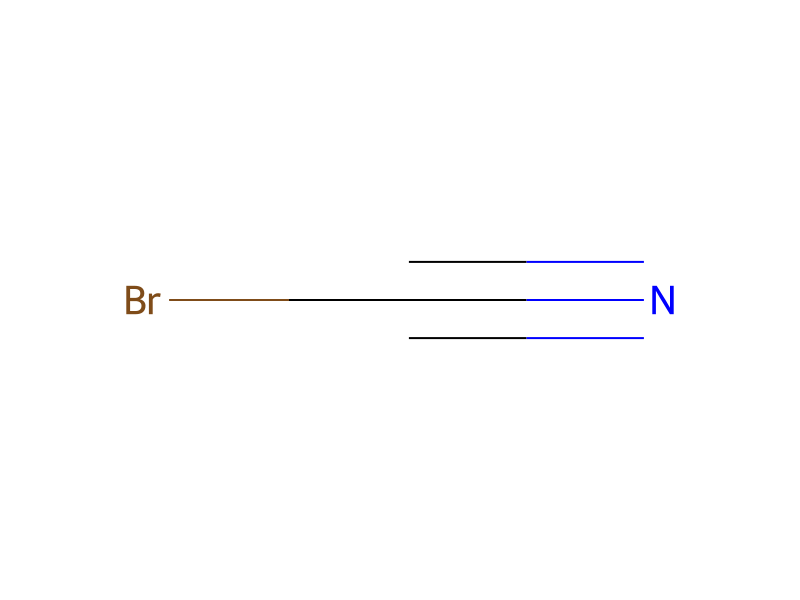
[N+:1]([C:4]1[C:10]([OH:11])=[CH:9][CH:8]=[CH:7][C:5]=1[OH:6])([O-])=O.[N:12]#[C:13]Br>CO.[Pd].O>[NH2:12][C:13]1[O:6][C:5]2[C:4](=[C:10]([OH:11])[CH:9]=[CH:8][CH:7]=2)[N:1]=1Participants
Reactant 2

Product 1

Reagents, catalysts & solvents 3



Procedure
To a stirred solution of 30 g (193 mmol) 2-nitroresorcinol in 900 ml methanol was added 2.00 g 10% palladium on charcoal, and the mixture was then stirred for 18 h at room temperature under an atmosphere of hydrogen. The mixture was then filtered and the filtrate, which contained 2-aminoresorcinol, added dropwise to a stirred solution of 22.5 g (213 mmol) cyanogen bromide in 230 ml methanol and 100 ml water. Stirring was continued for 2 h at room temperature, and then the mixture was concentrated in vacuo. To the residue was added aqueous sodium bicarbonate solution, and the mixture was extracted three times with ethyl acetate. The combined organic phases were washed with saturated brine, dried over sodium sulfate, and concentrated in vacuo. Flash chromatography (ethyl acetate) followed by trituration in ether afforded 27.0 g (93%) 2-amino-benzooxazol-4-ol as a beige crystalline solid. EI-MS m/e (%): 150 (M+, 100), 107 (28).
Workup
- filtrationThe mixture was then filtered
- stirringStirring
- waitwas continued for 2 h at room temperature
- concentrationthe mixture was concentrated in vacuo
- additionTo the residue was added aqueous sodium bicarbonate solution
- extractionthe mixture was extracted three times with ethyl acetate
- washThe combined organic phases were washed with saturated brine
- dry with materialdried over sodium sulfate
- concentrationconcentrated in vacuo
Sources & evidence
- ORD record
- ord-83e6bdfc8bae468896508c189f40d17e
- Source dataset
- uspto-grants-2006_01
- Patent number
- US06992083B2
Reaction notes
Loading…