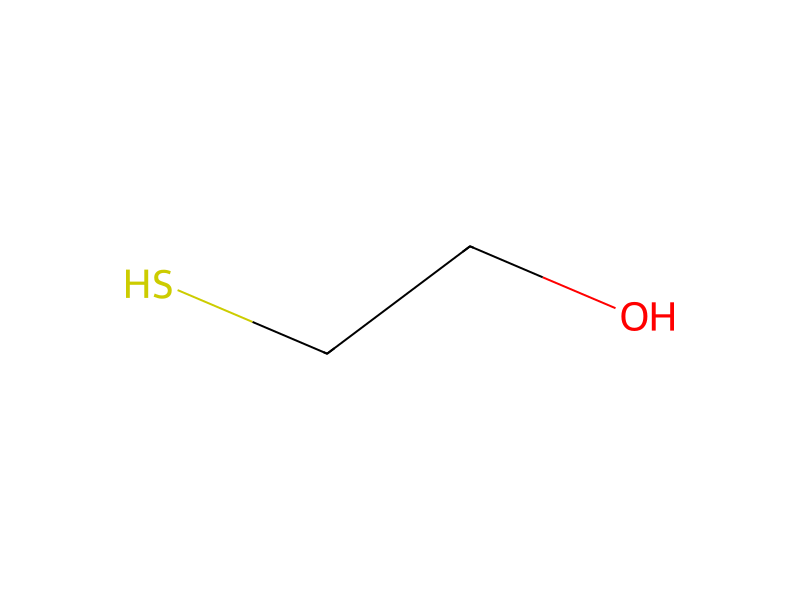
2-Mercaptoethanol → HCID 178428350, compound
Reaction equation

[CH3:1][C:2]1([CH3:14])[NH:7][C:6]2[C:8]([N:10]=[C:11]([NH2:13])[NH:12][C:5]=2[NH:4][CH2:3]1)=[O:9].BrBr.SCCO>CO>[CH3:1][C:2]1([CH3:14])[CH2:3][NH:4][C:5]2[C:6]([C:8](=[O:9])[N:10]=[C:11]([NH2:13])[N:12]=2)=[N:7]1Participants
Reactant 3


Product 1

Reagents, catalysts & solvents 1

Procedure
Quinoid-6,6-Me2PH2 is an intermediate in the synthesis of 6,6-Me2PH4 (see above). It can also be prepared quantitatively by bromine oxidation of 6,6-Me2PH4. The properties of q-6,6-Me2PH2 were determined on material made by the latter route. 6,6-Me2PH4 dihydrochloride, 0.1 mmoles, was dissolved in 3 ml methanol, and 22 mg Br2 (0.14 mmoles) was added. Removal of solvent by rotary evaporation left a dark orange film. The sample was repeatedly redissolved in 3 ml fresh methanol and evaporated to dryness for a total of 6 times, until the film was light yellow and no odor of bromine could be detected. Failure to remove the excess bromine resulted in complex absorbance changes that hindered spectral studies of q-6,6-Me2PH2. The quantitative yield was established by reduction back to 6,6-Me2PH4 using 2-mercaptoethanol, which resulting in full recovery of the original material.
Workup
- customRemoval of solvent
- customby rotary evaporation
- waitleft a dark orange film
- dissolutionThe sample was repeatedly redissolved in 3 ml fresh methanol
- customevaporated to dryness for a total of 6 times, until the film
- customFailure to remove the excess bromine
- customresulted in complex absorbance changes that
- customresulting in full recovery of the original material
Sources & evidence
- ORD record
- ord-79aa3588245048b7a79fe3543a4f28fe
- Source dataset
- uspto-grants-1993_03
- Patent number
- US05196533
Reaction notes
Loading…