Methyl iodide → 5-(2-Amino-pyrimidin-4-yl)-1-methyl-1H-pyrrole-3-carboxylic acid ethyl ester
Reaction equation
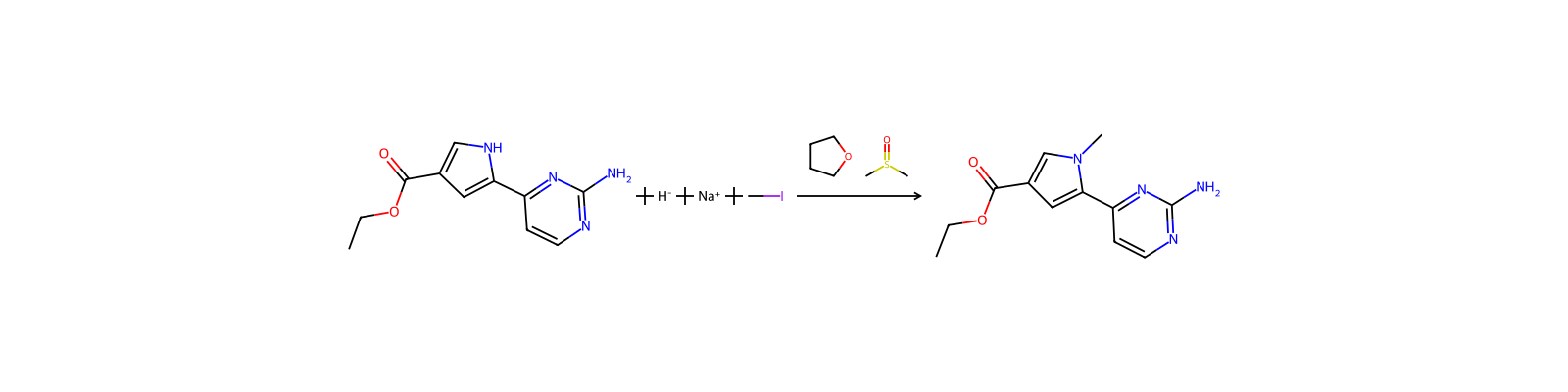
[CH2:1]([O:3][C:4]([C:6]1[CH:10]=[C:9]([C:11]2[CH:16]=[CH:15][N:14]=[C:13]([NH2:17])[N:12]=2)[NH:8][CH:7]=1)=[O:5])[CH3:2].[H-].[Na+].[CH3:20]I>O1CCCC1.CS(C)=O>[CH2:1]([O:3][C:4]([C:6]1[CH:10]=[C:9]([C:11]2[CH:16]=[CH:15][N:14]=[C:13]([NH2:17])[N:12]=2)[N:8]([CH3:20])[CH:7]=1)=[O:5])[CH3:2]Participants
Reactant 3



Product 1

Reagents, catalysts & solvents 2


Procedure
To a solution of 5-(2-amino-pyrimidin-4-yl)-1H-pyrrole-3-carboxylic acid ethyl ester (5.1 g, 21.96 mmol) in tetrahydrofuran (70 mL) and dimethylsulfoxide (15 mL) cooled in a ice-water bath, NaH (0.96 g, 24.15 mmol) and methyl iodide (1.5 mL, 24.15 mmol) were added. The reaction was continued at room temperature for 12 h, tetrahydrofuran was removed under vacuo, then dichloromethane (200 mL) was added and the organic phase washed with water (100 mL). The aqueous fraction was extracted with dichloromethane (100 mL). The organic fractions were combined, dried over sodium sulfate, filtered, and concentered in vacuo. Purification by flash chromatography on silica gel (eluant: dichloromethane/ethanol 95/5) provided 4.45 g (82%) of the title compound as a pale yellow solid.
Workup
- customtetrahydrofuran was removed under vacuo
- additiondichloromethane (200 mL) was added
- washthe organic phase washed with water (100 mL)
- extractionThe aqueous fraction was extracted with dichloromethane (100 mL)
- dry with materialdried over sodium sulfate
- filtrationfiltered
- customPurification by flash chromatography on silica gel (eluant: dichloromethane/ethanol 95/5)
Sources & evidence
- ORD record
- ord-55daa018dfc340c281ba199cf255b08f
- Source dataset
- uspto-grants-2014_07
- Patent number
- US08772280B2
Reaction notes
Loading…