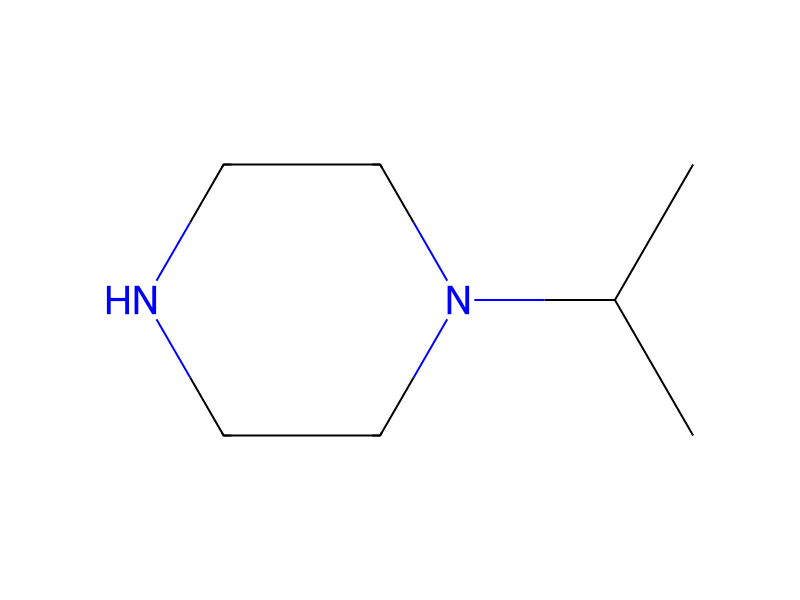
1-Isopropylpiperazine → HCID 121005082, compound
Reaction equation

[Cl:1][C:2]1[S:3][C:4]2[CH:10]=[C:9]([O:11][CH3:12])[CH:8]=[CH:7][C:5]=2[N:6]=1.[CH:13]([N:16]1[CH2:21][CH2:20][NH:19][CH2:18][CH2:17]1)([CH3:15])[CH3:14]>>[ClH:1].[CH:13]([N:16]1[CH2:21][CH2:20][N:19]([C:2]2[S:3][C:4]3[CH:10]=[C:9]([O:11][CH3:12])[CH:8]=[CH:7][C:5]=3[N:6]=2)[CH2:18][CH2:17]1)([CH3:15])[CH3:14]Participants
3


Conditions
- Temperature
- 120 °C
Procedure
A mixture of 2-chloro-6-methoxybenzothiazole (0.20 g, 1.0 mmol) and 1-isopropylpiperazine (0.26 g, 2.0 mmol) was stirred at 120° C. for 2 h. The reaction mixture was allowed to cool and worked up by extraction with ethyl acetate. The organic extract was washed with a NaHCO3 solution and water (3×). The organic phase was extracted with 0.25 M hydrochloric acid (10 mL). The acidic aqueous extract was concentrated and re-evaporated with ethanol. The residue was crystallized from a mixture of ethanol and ethyl acetate to give 260 mg (80%) of 2-(4-isopropylpiperazin-1-yl)-6-methoxybenzothiazole, hydrochloride.
Workup
- temperatureto cool
- extractionworked up by extraction with ethyl acetate
- extractionThe organic extract
- washwas washed with a NaHCO3 solution and water (3×)
- extractionThe organic phase was extracted with 0.25 M hydrochloric acid (10 mL)
- extractionThe acidic aqueous extract
- concentrationwas concentrated
- customre-evaporated with ethanol
- customThe residue was crystallized from a mixture of ethanol and ethyl acetate
Sources & evidence
- ORD record
- ord-6e0fc507026c4b3fa5dca3f8802d4644
- Source dataset
- uspto-grants-2014_07
- Patent number
- US08772285B2
Reaction notes
Loading…