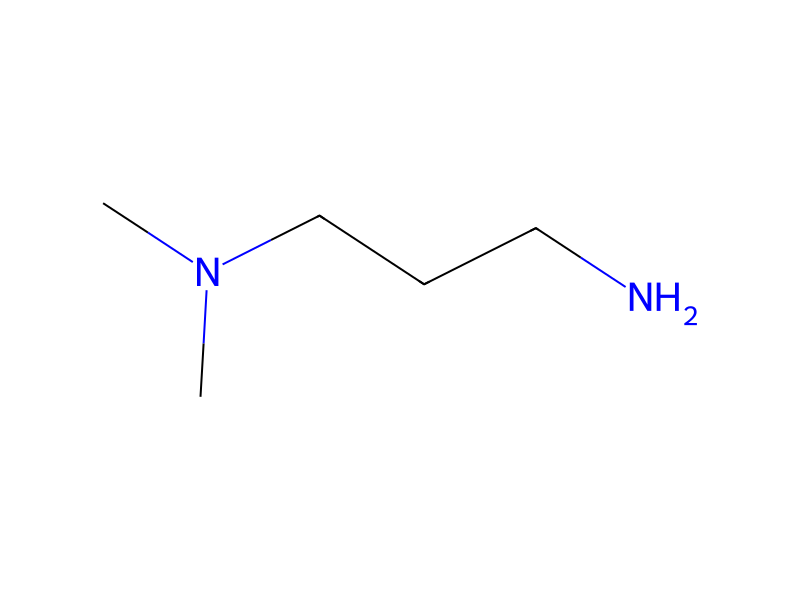
N,N-Dimethyl-1,3-propanediamine → N~1~,N~1~-Dimethyl-N~3~-(2,2,6,6-tetramethylpiperidin-4-yl)propane-1,3-diamine
Reaction equation

[CH3:1][C:2]1([CH3:11])[CH2:7][C:6](=O)[CH2:5][C:4]([CH3:10])([CH3:9])[NH:3]1.[CH3:12][N:13]([CH3:18])[CH2:14][CH2:15][CH2:16][NH2:17]>O>[CH3:12][N:13]([CH3:18])[CH2:14][CH2:15][CH2:16][NH:17][CH:6]1[CH2:7][C:2]([CH3:11])([CH3:1])[NH:3][C:4]([CH3:10])([CH3:9])[CH2:5]1Participants
Reactant 2

Product 1

Reagents, catalysts & solvents 1

Conditions
- Temperature
- 60 °C
Procedure
1808.9 g (11.65 mol) of 2,2,6,6-tetramethyl-4-piperidinone and 1191.1 g (11.66 mol) of N1,N1-dimethyl-1,3-propanediamine are combined in a 4 l reactor and stirred for 2 hours at 60° C. Then, the reaction water is distilled off in vacuum. Thereafter the reaction solution is transferred to an autoclave and admixed with 76 g of Raney nickel. The autoclave is flushed 3 times with 5 bar nitrogen each time. Then, the hydrogenation is carried out by repeated pressurization with 50 bar hydrogen, wherein the reaction mixture is stirred vigorously during the entire reaction time. Then, the reaction mixture is separated by fractional distillation. The product has a boiling point of 130° C. at 4.5 mbar. 2062 g of product could be isolated having a purity of 98.6% and a yield of 72% of theory.
Workup
- distillationis distilled off in vacuum
- customThe autoclave is flushed 3 times with 5 bar nitrogen each time
- stirringis stirred vigorously during the entire reaction time
- customThen, the reaction mixture is separated by fractional distillation
Sources & evidence
- ORD record
- ord-544f9d4ac7964d7cb7e8bc37a672ef96
- Source dataset
- uspto-grants-2014_07
- Patent number
- US08784537B2
Reaction notes
Loading…