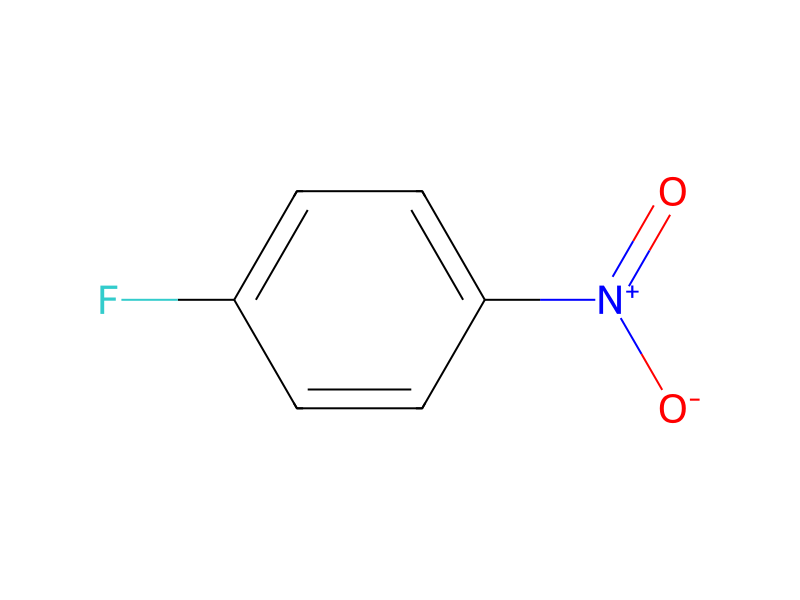
p-Fluoronitrobenzene → HCID 18677105, compound
Reaction equation

[CH3:1][S:2][C:3]1[NH:7][N:6]=[C:5]([C:8]2[CH:9]=[N:10][CH:11]=[CH:12][CH:13]=2)[CH:4]=1.CC(C)([O-])C.[K+].F[C:21]1[CH:26]=[CH:25][C:24]([N+:27]([O-:29])=[O:28])=[CH:23][CH:22]=1>CS(C)=O.O>[CH3:1][S:2][C:3]1[N:7]([C:21]2[CH:26]=[CH:25][C:24]([N+:27]([O-:29])=[O:28])=[CH:23][CH:22]=2)[N:6]=[C:5]([C:8]2[CH:9]=[N:10][CH:11]=[CH:12][CH:13]=2)[CH:4]=1Participants
6
Reactant 3


Product 1

Reagents, catalysts & solvents 2


Conditions
- Temperature
- 100 °C
Procedure
A solution of the above pyrazole(1.94 g, 10.15 mmol) and potassium t-butoxide (1.2 g, 10.6 mmol) in anhydrous DMSO (15 mL) was stirred at room temperature for 5 min and then 4-flouronitrobenzene (1.08 mL, 10.15 mmol) was added. The reaction mixture was heated to 100° C. in an oil bath for 5 h under argon. The reaction mixture was cooled, diluted with water, the yellow solid obtained was filtered, washed with water and dried. The residue obtained was recrystallized from ethyl acetate to give 5-methylthio-1-(4-nitrophenyl)-3-(3-pyridinyl)pyrazole (2.4 g).
Workup
- temperatureThe reaction mixture was cooled
- customthe yellow solid obtained
- filtrationwas filtered
- washwashed with water
- customdried
- customThe residue obtained
- customwas recrystallized from ethyl acetate
Sources & evidence
- ORD record
- ord-ca27f86923684b96b81e7a75f3caa41b
- Source dataset
- uspto-grants-2003_01
- Patent number
- US06506747B1
Reaction notes
Loading…