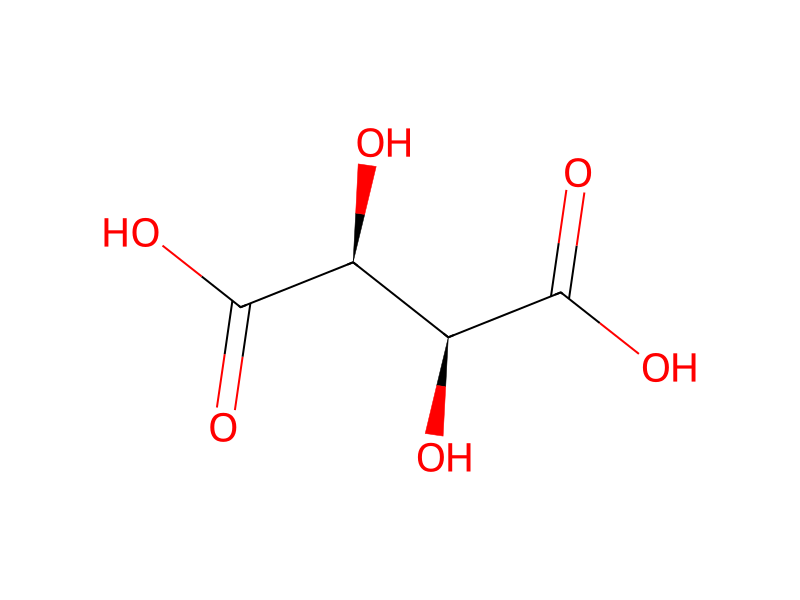
Azetidinecarboxylic Acid → AzeOH D-tartrate
Reaction equation

[C:1]([OH:10])(=[O:9])[C@H:2]([C@@H:4]([C:6]([OH:8])=[O:7])[OH:5])[OH:3].[NH:11]1[CH2:17][CH2:16][CH:12]1[C:13]([OH:15])=[O:14]>>[NH:11]1[CH2:17][CH2:16][C@H:12]1[C:13]([OH:15])=[O:14].[C:6]([C@H:4]([C@@H:2]([C:1]([O-:10])=[O:9])[OH:3])[OH:5])([O-:8])=[O:7]Participants


Procedure
Hydrogenation was carried out on the resultant pure title compound of Example 2 above (70.35 g; 250 mmol) in acetic acid (700 mL), using palladium on carbon catalyst. After hydrogenation was complete, the catalyst was filtered off, and the filtrates were concentrated resulting in a mixture containing a theoretical amount of 25.25 g D,L-AzeOH. Acetic acid was added to the residue, resulting in a 13.5% w/w solution of D,L-AzeOH in acetic acid. A D-tartaric acid resolution was carried out on 5.05 g (50 mmol) of D,L-AzeOH, in analogous fashion to procedures described in international patent application WO 97/41084, yielding 8.05 g (64%) of crude L-AzeOH-D-tartrate with a diastereomeric excess of 95.8%. The crude salt was recrystallised from aqueous ethanol, yielding 6.28 g of pure L-AzeOH-D-tartrate as white crystals. HPLC indicated a diastereomeric excess of 100%.
Sources & evidence
- ORD record
- ord-69a62f07cac14f889092f51a2e81d938
- Source dataset
- uspto-grants-2003_01
- Patent number
- US06506907B1
Reaction notes
Loading…