
HRID 4778반응물로
D-Tartaric acid
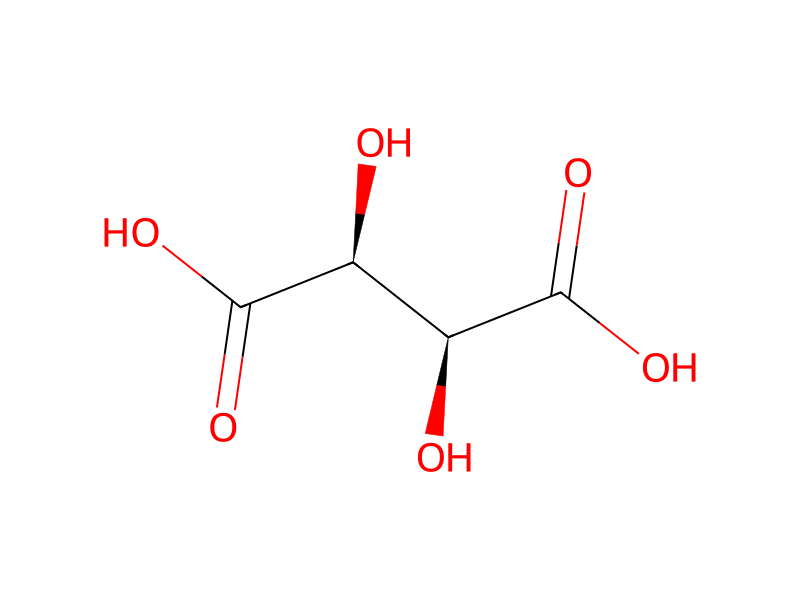
133-37-9O=C(O)[C@@H](O)[C@H](O)C(=O)OFEWJPZIEWOKRBE-LWMBPPNESA-ND-tartaric acid is the D-enantiomer of tartaric acid. It has a role as an Escherichia coli metabolite. It is a conjugate acid of a D-tartrate(1-). It is an enantiomer of a L-tartaric acid.
Other Classes -> Organic Acids
Other Classes -> Organic Acids
Liquid; Other Solid
White solid; [ICSC] Colorless or white odorless solid; [JECFA] White odorless crystalline powder; [Acros Organics MSDS]
Solid; [Merck Index] White odorless crystalline powder; [Alfa Aesar MSDS]
Solid
119.1 Ų [M-H]- [CCS Type: DT; Buffer gas: N2; Ionization: ESI-; Dataset: TOXCAST; Source Identifier: DTXSID5046986]
118.3 Ų [M-H]-
안전 정보는 참고용이며, 공급업체의 물질안전보건자료(SDS), 관련 법규 및 전문가 평가를 대체하지 않습니다.
This chemical does not meet GHS hazard criteria for 5.1% (26 of 506) of reports.
Danger
H315 (22.1%): Causes skin irritation [Warning Skin corrosion/irritation]
P261, P264, P264+P265, P271, P280, P302+P352, P304+P340, P305+P351+P338, P305+P354+P338, P317, P319, P321, P332+P317, P337+P317, P362+P364, P403+P233, P405, and P501 (click each P-code to see the statement)
Aggregated GHS information provided per 506 reports by companies from 13 notifications to the ECHA C&L Inventory. Each notification may be associated with multiple companies.
This chemical does not meet GHS hazard criteria for 1% (3 of 310) of reports.
Chemical: Butanedioic acid, 2,3-dihydroxy-, (R*,R*)-(.+-.)-
Chemical: Butanedioic acid, 2,3-dihydroxy-, [S-(R*,R*)]-
Butanedioic acid, 2,3-dihydroxy-, (2S,3S)- is listed on the EPA's Chemical Data Reporting (CDR) system. Manufacturers and importers of Butanedioic acid, 2,3-dihydroxy-, (2S,3S)- are required to report information about their production and use of this chemical to the EPA under the Toxic Substances Control Act (TSCA). (40 eCFR Part 711)
REACH registered substance: (-)-tartaric acid (EC: 205-695-6)
REACH registered substance: (±)-tartaric acid (EC: 205-105-7)
D-Tartaric acid: Does not have an individual approval but may be used under an appropriate group standard
IMAP assessments - Butanedioic acid, 2,3-dihydroxy-, (R*,R*)-(.+-.)-: Human health tier I assessment
Evaluation - Chemicals that are unlikely to require further regulation to manage risks to environment
Causes burns; Inhalation of aerosol may cause pulmonary edema; [ICSC] An irritant; [Acros Organics MSDS]
A skin, respiratory tract, and strong eye irritant; [Alfa Aesar MSDS]
Used as a synergist for antioxidants, acid, emulsifier, sequestrant, and flavoring agent; [JECFA]
Dextro configuration of levorotatory tartaric acid; Called unnatural but has been found in nature; [Merck Index]
Fragrance Ingredients
Flavouring Agent -> FLAVOURING_AGENTFood Additives -> ACID; ANTIOXIDANT_SYNERGIST; EMULSIFIER; SEQUESTRANT; SYNERGIST -> JECFA Functional Classes
출처d-Tartaric acid occurs in many fruits or other parts of the plant, free or combined with potassium, calcium or magnesium. It is also reported found in raw, lean fish, white wine, red wine and port wine.
용도DL-Tartaric acid is used as a synergist for antioxidants, emulsifier, sequestrant and flavoring agent. It is also added with citric acid to prepare effervescent salts, thereby enhancing the taste of oral medications. It is also utilized in pigments, processing aids, ink, toner and colorant products. It acts as a chelating agent in metal and farming industries. Further, it is used as lubricant and grease. It is mixed with sodium bicarbonate and used as a leavening agent in food preparation. In the pharmaceutical industry, it is utilized in the preparation of tartar emetic, which is used in cough syrup as an expectorant.




133-37-9、147-71-7DTXSID4043775CHEMBL1200861CHEBI:15672DL-Tartaric acid is a water- and alcohol-soluble colorless crystalline solid with a characteristic acid taste and a melting temperature of 170°C(338°F). Naturally occurring tartaric acid is generally of the L-configuration (based on the absolute configuration of D-glyceric acid). The L-forms of tartrates are dextrorotatory in solution and thus are designated as L(+)-tartrates. It is also known as dihydroxy succinic acid. Tartaric acid is used as a chemical intermediate and a sequestrant,as well as in tanning, effervescent beverages, baking powder, ceramics, photography, textile processing,mirror silvering,and metal coloring.
Skin Irrit. 2 (22.1%)
Skin Irrit. 2 (23.5%)
The tartrates used in commerce are obtained as a by-product of wine manufacture and have the L(+) configuration. Produced from argols or wine lees, which are formed in the manufacture of wine by extracting the potassium acid tartrate, transforming this into the calcium salt and then acidifying with dilute sulfuric acid; also by oxidation of d-glucose with nitric acid. The dl-tartaric acid is obtained by boiling the d-tartaric acid with an aqueous solution of NaOH or by oxidation of fumaric acid. The l- and the meso-tartaric acid are also known, but are less important.
순도시험(1) 융점 : 이 품목의 융점은 200~206℃이어야 한다. (2) 황산염 : 「L-주석산」의 순도시험 (2)에 따라 시험한다. (3) 비소 : 이 품목을 비소시험법에 따라 시험할 때, 그 양은 4.0ppm 이하이어야 한다. (4) 납 : 이 품목 5.0g을 취하여 원자흡광광도법 또는 유도결합플라즈마발광광도법에 따라 시험할 때, 그 양은 2.0ppm 이하이어야 한다. (5) 산화되기 쉬운 물질 : 이 품목 1g에 물 25mL 및 묽은황산 25mL를 가하여 녹이고 이를 20℃로 유지하면서 0.1N 과망간산칼륨용액 4mL를 가할 때, 시액의 색이 3분 이내에 없어져서는 아니 된다.
확인시험(1) 이 품목의 수용액(1→10)은 선광성을 가지고 있지 않다. (2) 「L-주석산」의 확인시험 (2), (3) 및 (4)에 따라 시험한다.
정량법「L-주석산」의 정량법에 따라 정량한다.
정의ChEBI: DL-Tartaric acid is a tetraric acid that is butanedioic acid substituted by hydroxy groups at positions 2 and 3. It has a role as a human xenobiotic metabolite and a plant metabolite. It is a conjugate acid of a 3-carboxy-2,3-dihydroxypropanoate.