Imidazolone → Glufosinate
Reaction equation

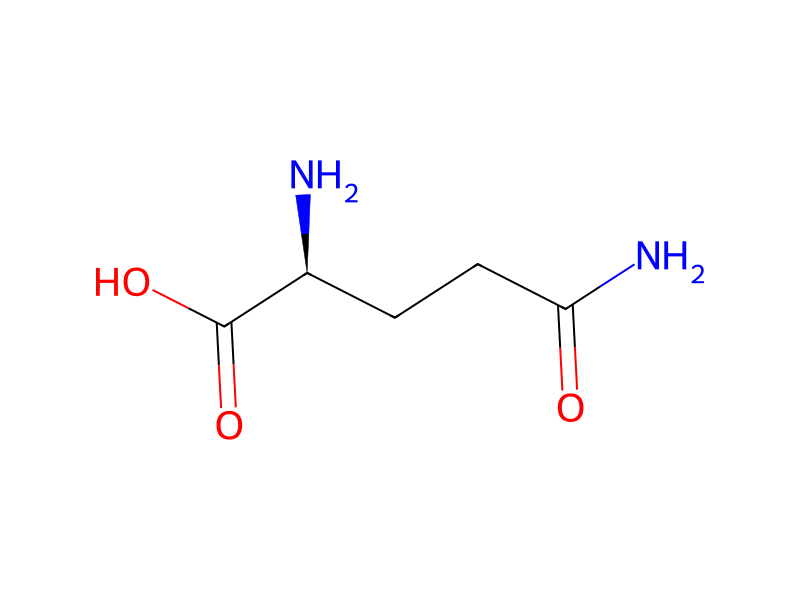
C1N=CNC1=O.N[C@H](C(O)=O)CCC(=O)N.[CH3:17][P:18]([OH:27])([CH2:20][CH2:21][C@H:22]([NH2:26])[C:23]([OH:25])=[O:24])=[O:19].CS(CCC(N)C(O)=O)(=O)=N>>[CH3:17][P:18]([OH:27])([CH2:20][CH2:21][C@H:22]([NH2:26])[C:23]([OH:25])=[O:24])=[O:19].[CH3:17][P:18]([OH:27])([CH2:20][CH2:21][CH:22]([NH2:26])[C:23]([OH:25])=[O:24])=[O:19]Participants



Procedure
Where more than one trait are introgressed into inbred sweet corn line R398D, it is preferred that the specific genes are all located at the same genomic locus in the donor, non-recurrent parent, preferably, in the case of transgenes, as part of a single DNA construct integrated into the donor's genome. Alternatively, if the genes are located at different genomic loci in the donor, non-recurrent parent, backcrossing allows to recover all of the morphological and physiological characteristics of inbred sweet corn line R398D in addition to the multiple genes in the resulting sweet corn inbred line. The genes responsible for a specific, single gene trait are generally inherited through the nucleus. Known exceptions are, e.g. the genes for male sterility, some of which are inherited cytoplasmically, but still act as single gene traits. In a preferred embodiment, a transgene to be introgressed into sweet corn inbred line R398D is integrated into the nuclear genome of the donor, non-recurrent parent. In another preferred embodiment, a transgene to be introgressed into sweet corn inbred line R398D is integrated into the plastid genome of the donor, non-recurrent parent. In a preferred embodiment, a plastid transgene comprises one gene transcribed from a single promoter or two or more genes transcribed from a single promoter. In a preferred embodiment, a transgene whose expression results or contributes to a desired trait to be transferred to sweet corn inbred line R398D comprises a virus resistance trait such as, for example, a MDMV strain B coat protein gene whose expression confers resistance to mixed infections of maize dwarf mosaic virus and maize chlorotic mottle virus in transgenic maize plants (Murry et al. Biotechnology (1993) 11:1559-64, incorporated herein by reference). In another preferred embodiment, a transgene comprises a gene encoding an insecticidal protein, such as, for example, a crystal protein of Bacillus thuringiensis or a vegetative insecticidal protein from Bacillus cereus, such as VIP3 (see for example Estruch et al. Nat Biotechnol (1997) 15:137-41, incorporated herein by reference). In a preferred embodiment, an insecticidal gene introduced into inbred sweet corn line R398D is a Cry1Ab gene or a portion thereof, for example introgressed into sweet corn inbred line R398D from a maize line comprising a Bt-11 event as described in U.S. application Ser. No. 09/042,426, incorporated herein by reference, or from a maize line comprising a 176 event as described in Koziel et al. (1993) Biotechnology 11: 194-200, incorporated herein by reference. In yet another preferred embodiment, a transgene introgressed into sweet corn inbred line R398D comprises a herbicide tolerance gene. For example, expression of an altered acetohydroxyacid synthase (AHAS) enzyme confers upon plants tolerance to various imidazolinone or sulfonamide herbicides (U.S. Pat. No. 4,761,373, incorporated herein by reference). In another preferred embodiment, a non-transgenic trait conferring tolerance to imidazolinones is introgressed into sweet corn inbred line R398D (e.g a "IT" or "IR" trait). U.S. Pat. No. 4,975,374, incorporated herein by reference, relates to plant cells and plants containing a gene encoding a mutant glutamine synthetase (GS) resistant to inhibition by herbicides that are known to inhibit GS, e.g. phosphinothricin and methionine sulfoximine. Also, expression of a Streptomyces bar gene encoding a phosphinothricin acetyl transferase in maize plants results in tolerance to the herbicide phosphinothricin or glufosinate (U.S. Pat. No. 5,489,520, incorporated herein by reference). U.S. Pat. No. 5,013,659, incorporated herein by reference, is directed to plants that express a mutant acetolactate synthase (ALS) that renders the plants resistant to inhibition by sulfonylurea herbicides. U.S. Pat. No. 5,162,602, incorporated herein by reference, discloses plants tolerant to inhibition by cyclohexanedione and aryloxyphenoxypropanoic acid herbicides. The tolerance is conferred by an altered acetyl coenzyme A carboxylase(ACCase). U.S. Pat. No. 5,554,798, incorporated herein by reference, discloses transgenic glyphosate tolerant maize plants, which tolerance is conferred by an altered 5-enolpyruvyl-3-phosphoshikimate (EPSP) synthase gene. Also, tolerance to a protoporphyrinogen oxidase inhibitor is achieved by expression of a tolerant protoporphyrinogen oxidase enzyme in plants (U.S. Pat. No. 5,767,373, incorporated herein by reference).
Workup
- customto recover all of the morphological and physiological characteristics of inbred sweet corn line R398D
- additionin addition to the multiple genes in the resulting sweet corn
- customIn a preferred embodiment, a transgene whose expression results
- additionto mixed infections of maize dwarf mosaic virus
- additionIn a preferred embodiment, an insecticidal gene introduced into inbred sweet corn line R398D
- additioncontaining a gene
Sources & evidence
- ORD record
- ord-0e49a69d5a3a42ed92548acc30055e85
- Source dataset
- uspto-grants-2000_03
- Patent number
- US06034306
Reaction notes
Loading…