Bromine → 2-Bromoisooctadecanoyl chloride
반응식

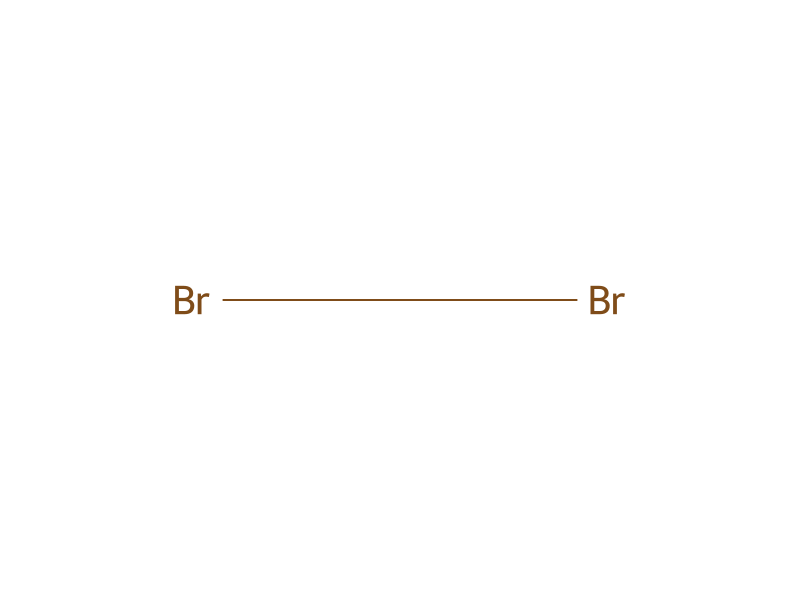
[C:1]([Cl:20])(=[O:19])[CH2:2][CH2:3][CH2:4][CH2:5][CH2:6][CH2:7][CH2:8][CH2:9][CH2:10][CH2:11][CH2:12][CH2:13][CH2:14][CH2:15][CH:16]([CH3:18])[CH3:17].[Br:21]Br>>[Br:21][CH:2]([CH2:3][CH2:4][CH2:5][CH2:6][CH2:7][CH2:8][CH2:9][CH2:10][CH2:11][CH2:12][CH2:13][CH2:14][CH2:15][CH:16]([CH3:17])[CH3:18])[C:1]([Cl:20])=[O:19]참가 물질


실험 절차
Isooctadecanoyl chloride prepared as described in Example 5 (20.2 g) was stirred and heated to 100° and illuminated with a tungsten lamp (100 watts) whilst bromine (10.7 g) was added dropwise during 1.5 hours. Heating and stirring under illumination were continued and further additions of bromine were made until after 10 hours and the addition of a further 6 g of bromine, 95% of the starting material was shown by gas chromatography to be completely reacted. Excess bromine and hydrobromic acid were removed by applying vacuum (20 mm of mercury) to the heated liquid. The 2-bromoisooctadecanoyl chloride thus obtained was cooled and treated with 1,2,4-triazole (9.0 g) and drowned into water and extracted with petroleum ether (b.p. 60°-80° ). The organic solution was separated and washed with aqueous hydrochloric acid (2M) and water, and the solvent was distilled leaving 1-(2'-bromoiso- octadecanoyl)-1,2,4-triazole (25.3 g) as a pale brown oil. The nuclear magnetic resonance spectrum of the product as a solution in deuterated chloroform was compared with that of the product of Example 5, confirming that absorption at delta 3.4 ppm from tetramethylsilane, associated with a proton in the 2'-position of the side chain, had vanished. This compound was evaluated as an extractant for copper by the procedure of Example 1 and the results are presented in Table 1. The results show that the compound is a slightly "weaker" ligand than the products of Examples 1-7, and that it transfers only a small amount of acid.
후처리
- temperatureheated to 100°
- additionwas added dropwise during 1.5 hours
- temperatureHeating
- stirringstirring under illumination
- customafter 10 hours
- customto be completely reacted
- customExcess bromine and hydrobromic acid were removed
출처 및 근거
- ORD 기록
- ord-88410defd12845f8b43b74dedb6bec2a
- 출처 데이터셋
- uspto-grants-1989_11
- 특허 번호
- US04879388
반응 노트
불러오는 중…