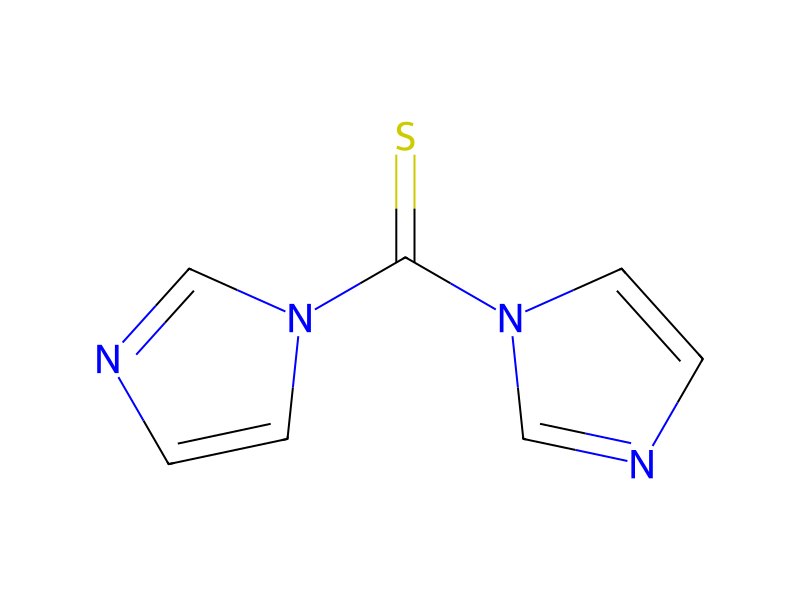
1,1'-Thiocarbonyldiimidazole → HCID 14625406, compound
Reaction equation

[N+:1]([C:4]1[CH:9]=[CH:8][CH:7]=[CH:6][C:5]=1[N:10]1[CH2:16][CH2:15][N:14]([C:17]2[CH:22]=[CH:21][CH:20]=[CH:19][CH:18]=2)[CH2:13][CH2:12][NH:11]1)([O-])=O.[C:23](N1C=CN=C1)(N1C=CN=C1)=[S:24]>COCCOC.C(Cl)(Cl)Cl>[C:17]1([N:14]2[CH2:15][CH2:16][N:10]3[C:5]4[CH:6]=[CH:7][CH:8]=[CH:9][C:4]=4[NH:1][C:23](=[S:24])[N:11]3[CH2:12][CH2:13]2)[CH:22]=[CH:21][CH:20]=[CH:19][CH:18]=1Participants
Reactant 2

Product 1

Reagents, catalysts & solvents 2


Procedure
Hexahydro-1-(2-nitrophenyl)-5-phenyl-1H-1,2,5-triazepine (22.4 g) was hydrogenated in 1,2-dimethoxyethane (800 ml) as in Example 11 and the volume reduced to 250 ml. 1,1'-Thiocarbonyldiimidazole (27 g) was added and the mixture, protected from moisture, was heated under reflux on a steam bath overnight. The solution was evaporated to dryness. The residue was dissolved in toluene and applied to a column (63×8.0 cm) of dry column grade neutral alumina prepacked in toluene. Elution with toluene (several liters) removed a faster moving yellow component from the column. The eluting solvent was changed to toluene-chloroform (4:1, 2 l) and then to chloroform. Monitoring of fractions was by t.l.c. on Alox-25 uv254 plates (Brinkmann) with chloroform as developer and on silica gel GF (Analtech) plates with chloroform as developer. A slightly faster moving minor purple component was eluted in the earlier fractions containing the major component. In later fractions a slower moving yellow component contaminated the major component. The first fractions (having none of the slower yellow minor component) were evaporated to smaller volume. Coevaporation with toluene caused crystallization. Addition of heptane completed the process; wt. 12.46 g (crop 1), mp=206°-208°. The later yellow fractions similarly gave 5.33 g (crop 2), mp=203°-208° of crude titled product. Recrystallization of crop 2 (from chloroform-toluene-heptane) gave material which was combined with crop 1. This material was dissolved in chloroform and the solution was decolorized. Evaporation to smaller volume followed by coevaporation with toluene and addition of heptane gave 17.6 g (76%) of crude titled product, mp=205°-209°. Recrystallization from the same solvent system gave titled product, mp=205°-208°.
Workup
- temperaturewas heated
- temperatureunder reflux on a steam bath overnight
- customThe solution was evaporated to dryness
- dissolutionThe residue was dissolved in toluene
- washElution with toluene (several liters)
- customremoved
- washwas eluted in the earlier fractions
- additioncontaining the major component
- customwere evaporated to smaller volume
- customcrystallization
- additionAddition of heptane
- customRecrystallization of crop 2 (from chloroform-toluene-heptane)
- customgave material which
- customEvaporation to smaller volume
- additionfollowed by coevaporation with toluene and addition of heptane
- customgave 17.6 g (76%) of crude titled product, mp=205°-209°
- customRecrystallization from the same solvent system
Sources & evidence
- ORD record
- ord-1d3554263fbb46a5afc25f96615beaa7
- Source dataset
- uspto-grants-1989_11
- Patent number
- US04882323
Reaction notes
Loading…