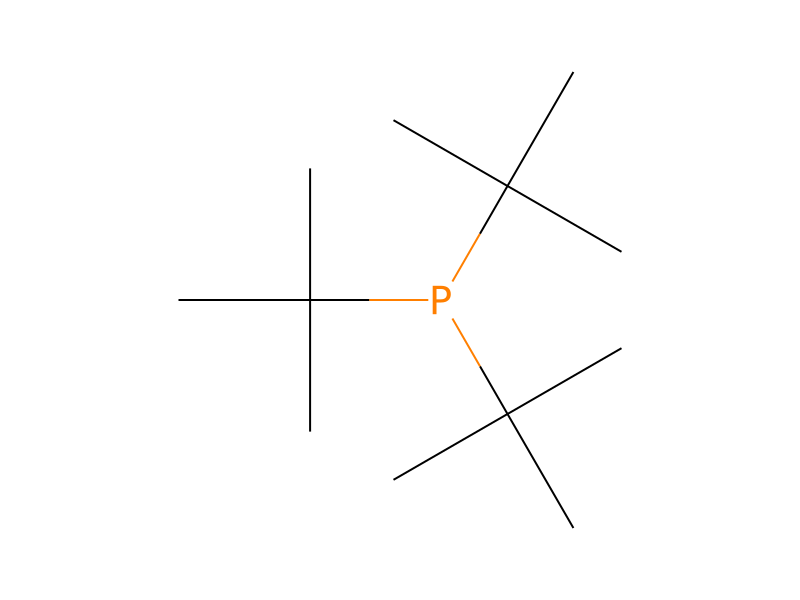
Tris(1,1-dimethylethyl)phosphine → 2-(4'-Vinyl-biphenyl-4-yl)pyridine
Reaction equation

[CH:1]([C:3]1[CH:8]=[CH:7][C:6](B(O)O)=[CH:5][CH:4]=1)=[CH2:2].Cl[C:13]1[CH:18]=[CH:17][C:16]([C:19]2[CH:24]=[CH:23][CH:22]=[CH:21][N:20]=2)=[CH:15][CH:14]=1.F[K].C(P)(C)(C)C.P(C(C)(C)C)(C(C)(C)C)C(C)(C)C>C(=CC(C=CC1C=CC=CC=1)=O)C1C=CC=CC=1.C(=CC(C=CC1C=CC=CC=1)=O)C1C=CC=CC=1.C(=CC(C=CC1C=CC=CC=1)=O)C1C=CC=CC=1.[Pd].O1CCOCC1>[CH:1]([C:3]1[CH:8]=[CH:7][C:6]([C:13]2[CH:14]=[CH:15][C:16]([C:19]3[CH:24]=[CH:23][CH:22]=[CH:21][N:20]=3)=[CH:17][CH:18]=2)=[CH:5][CH:4]=1)=[CH2:2]Participants
Reactant 5


Product 1

Reagents, catalysts & solvents 2

Conditions
- Temperature
- 80 °C
Procedure
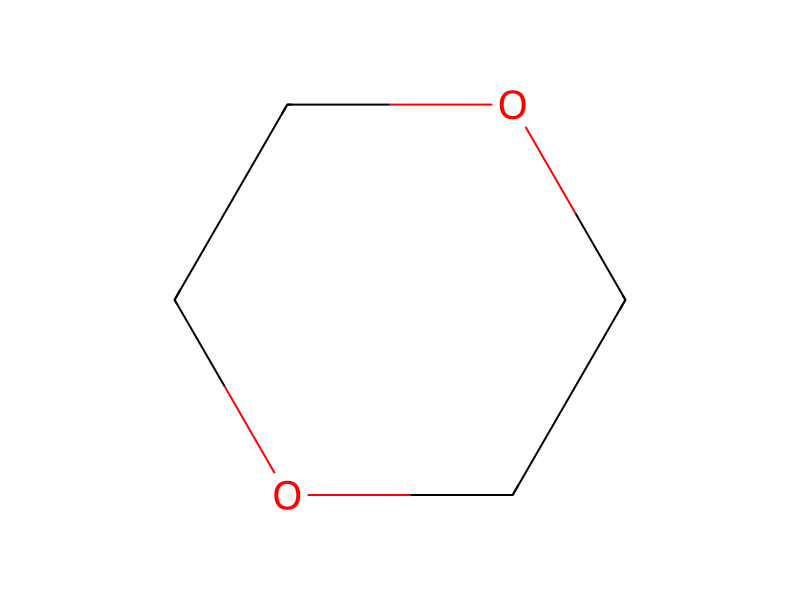
Under a nitrogen stream, 23.42 g (0.158 mol) of 4-vinyl-phenyl boronic acid, 20.0 g (0.1055 mol) of 2-(4-chloro-phenyl)pyridine, 500□ of 1,4-dioxane, 27.54 g (0.474 mol, 3.3 equivalent) of fluoro-potassium, 1.69 g (0.0084 mol, 5.3 mol %) of t-butylphosphine [P(t-Bu)3)], and 2.6 g (0.0028 mol, 1.8 mol %) of palladium tris(dibenzylidene acetone) [Pd2(dba)3] were placed into a 2-neck round flask 250□. After the resulting solution was heated to reflux at 80° C. for 24 hours, the reaction was terminated. The resulting mixture was filtered, the catalyst and fluoro-potassium that were black solids were removed, and then the dioxane was removed by rotary evaporation. After extraction with 300□ of dichloromethane and 400□ of distilled water, the residue was subjected to column chromatography using a mixed solution of hexane and ethylacetate (7:3) as a developing solvent and then recrystallized at 0° C. using ethylacetate to give the 2-(4′-vinyl-biphenyl-4-yl)pyridine. The yield was 45%. As the structural characteristics of the thus prepared 2-(4′-vinyl-biphenyl-4-yl)pyridine, the 1H-NMR spectrum is shown in FIG. 2, the UV/Vis is shown in FIG. 3, the GC-Mass is shown in FIG. 4, and the FT-IR is shown in FIG. 5. Moreover, the analysis data of the 2-(4′-vinyl-biphenyl-4-yl)pyridine is shown in the following table 1:
Workup
- temperatureAfter the resulting solution was heated
- customthe reaction was terminated
- filtrationThe resulting mixture was filtered
- customwere removed
- customthe dioxane was removed by rotary evaporation
- extractionAfter extraction with 300□ of dichloromethane and 400□ of distilled water
- customrecrystallized at 0° C.
Sources & evidence
- ORD record
- ord-1455a27782084f089190e0cebd8c079e
- Source dataset
- uspto-grants-2012_02
- Patent number
- US08110642B2
Reaction notes
Loading…